Skip to content
Philoid
Browse Saved
Back to chapter
Maths
12. Mathematical Induction
Home · Class 11 · Maths · Ref. Book · 12. Mathematical Induction
Prev
Next
Q49 of 66 Page 12

Using principle of mathematical induction prove that

for all natural numbers n ≥ 2.


Step1: For n=2, P(n):



Therefore, it is true for n=2.


Step2: Let P(n) be true for n=k.



Now, we need to show P(k+1) is true whenever P(k) is true.


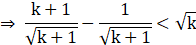
P(k+1):



So, it is true for n=k+1, thus by the principle of mathematical induction P(n) is true for all n ≥ 2


More from this chapter

All 66 →
47

A sequence x1, x2, x3, …. is defined by letting x1 = 2 and for all natural numbers k, k ≥ 2. Show that for all nϵN

48

A sequence x0, x1, x2, x3, …. is defined by letting x0 = 5 and

xk =4+xk–1 for all natural numbers k. Show that xn = 5 for all


nϵN using mathematical induction.

50

The distributive law from algebra states that for real numbers

c, a1 and a2, we have c(a1 + a2) = c a1 + ca2


Use this law and mathematical induction to prove that, for all


natural numbers, n ≥ 2, if c, a1, a2, …... an are any real numbers,


then c(a1 + a2 +…+ an) = c a1 + c a2 +…+ c an.

1

State the first principle of mathematical induction.

Questions · 66
12. Mathematical Induction
1 2 3 4 5 6 1 2 3 4 5 6 7 8 9 10 11 12 13 14 15 16 17 18 19 20 21 22 23 24 25 26 27 28 29 30 31 32 33 34 35 36 37 38 39 40 41 42 43 44 45 46 47 48 49 50 1 2 3 4 1 2 3 4 5 6
Back to chapter
ADVERTISEMENT
About Contact Privacy Terms
Philoid · 2026
  • Home
  • Search
  • Browse
  • Quiz
  • Saved