Skip to content
Philoid
Browse Saved
Back to chapter
Maths
5. Complex Numbers and Quadratic Equations
Home · Class 11 · Maths · Ref. Book · 5. Complex Numbers and Quadratic Equations
Prev
Next
Q3 of 202 Page 188

If (x + iy)3 = (u + iv) then prove that = 4 (x2 – y2).

Given that, (x + iy)3 = (u + iv)


⇒ x3 + (iy)3 + 3x2iy + 3xi2y2 = u + iv


⇒ x3 - iy3 + 3x2iy - 3xy2 = u + iv


⇒ x3 - 3xy2 + i(3x2y - y3) = u + iv


On equating real and imaginary parts, we get


U = x3 - 3xy2 and v = 3x2y - y3


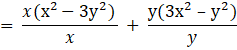
Now ,



= x2 - 3y2 + 3x2 - y2


= 4x2 - 4y2


= 4(x2 - y2)


Hence,


More from this chapter

All 202 →
1

Express each of the following in the form (a + ib) and find its conjugate.

(i)


(ii) (2 + 3i)2


(iii)


(iv)


(v)


(vi)


2

Express each of the following in the form (a + ib) and find its multiplicative inverse:

(i)


(ii)


(iii)


4

If (x + iy)1/3 = (a + ib) then prove that = 4 (a2 – b2).

5

Express (1 – 2i)–3 in the form (a + ib).

Questions · 202
5. Complex Numbers and Quadratic Equations
1 1 2 2 3 3 4 4 5 5 6 6 7 7 8 8 9 9 10 10 11 11 12 12 13 13 14 14 15 15 1 1 1 1 1 1 1 1 2 2 2 2 2 2 2 2 2 3 3 3 3 3 3 3 3 3 4 5 6 7 8 9 9 9 9 9 9 9 9 10 10 10 10 10 10 10 10 11 11 11 11 12 13 14 15 16 17 18 19 20 21 21 21 21 21 21 22 23 24 25 26 27 28 1 2 3 4 5 6 7 8 9 10 11 12 1 2 3 4 5 6 7 8 9 10 11 12 13 14 15 16 17 18 19 20 21 22 23 24 1 2 3 4 5 6 7 8 9 10 11 12 13 14 15 16 17 18 19 20 21 1 2 3 4 5 6 7 8 9 10 11 12 1 14 1 2 3 4 5 6 7 8 9 10 11 12 13 14 15 16 17 18 19 20 21 22 23 24 25 26 27 28
Back to chapter
ADVERTISEMENT
About Contact Privacy Terms
Philoid · 2026
  • Home
  • Search
  • Browse
  • Quiz
  • Saved