
Mark the correct alternative in each of the following:
Let A and B be two events such that P(A) = 0.6, P(B) = 0.2 and P(A/B) = 0.5. Then  equals.
P(A) = 0.6 , P(B) = 0.2 , P = 0.5 → (Given)

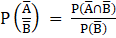
 → (1)
→ (1)

= 1 – 0.2
= 0.8
Also,


= 1 – P(A⋃B) → (3)
Using (2) & (3) in Equation (1) we get,
 → (3)
→ (3)
Now,

P(A∩B) = 0.5  P(B) → From (Given)
P(A∩B) = 0.5  0.2
0.2
P(A∩B) = 0.1
According to the addition theorem of probability,
P(A⋃B) = P(A) + P(B) – P(A⋂B)
= 0.6 + 0.2 – 0.1
= 0.8 – 0.1
= 0.7 → (4)
Putting (4) in equation (3) we get,


AI is thinking…
Couldn't generate an explanation.
Generated by AI. May contain inaccuracies — always verify with your textbook.
