
A company has two plants to manufacture bicycles. The first plant manufactures 60% of the bicycles and the second plant 40%. Out of that 80% of the bicycles are rated of standard quality at the first plant and 90% of standard quality at the second plant. A bicycle is picked up at random and found to be standard quality. Find the probability that it comes from the second plant.
Let us assume U1, U2 and A be the events as follows:
U1 = Choosing first plant to manufacture bicycles
U2 = choosing second plant to manufacture bicycles
A = Picking standard quality cycle
From the Problem
⇒ 
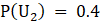
⇒ 
⇒ P(A|U1) = P(Picking standard quality cycle from first plant)
⇒ 
⇒ P(A|U2) = P(Picking standard quality cycle from second plant)
⇒ 
Now we find
P(U2|A) = P(The chosen standard quality cycle is from second plant)
Using Baye’s theorem:
⇒ 
⇒ 
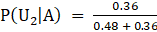
⇒ 
⇒ 
⇒ 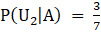
∴ The required probability is  .
.
Couldn't generate an explanation.
Generated by AI. May contain inaccuracies — always verify with your textbook.