
A manufacturer has three machine operators A,B and C. The first operator A produces 1% defective items, whereas the other two operators B and C produce 5% and 7% defective items respectively. A is on the job for 50% of the time, B on the job for 30% of the time and C on the job for 20% of the time. A defective item is produced. What is the probability that it was produced by A?
Let us assume U1, U2, U3 and A be the events as follows:
U1 = choosing Operator A
U2 = choosing Operator B
U3 = choosing Operator C
A = Producing defective item
From the problem:
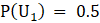
⇒ 
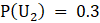
⇒ 
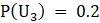
⇒ 
⇒ P(A|U1) = P(Producing defective item by operator A)
⇒ 
⇒ P(A|U2) = P(Producing defective item by operator B)
⇒ 
⇒ P(A|U3) = P(Producing defective item by operator C)
⇒ 
Now we find
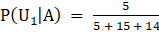
P(U1|A) = P(The defective item is produced by operator A)
Using Baye’s theorem:
⇒ 
⇒ 
⇒ 
⇒ 
∴ The required probability is  .
.
Couldn't generate an explanation.
Generated by AI. May contain inaccuracies — always verify with your textbook.
