Q26 of 65 Page 77

Figure shows a cylindrical tube with adiabatic walls and fitted with an adiabatic separator. The separator can be slid into the tube by an external mechanism. An ideal gas (γ= 1.5) is injected in the two aides at equal pressures and temperatures. The separator remains in equilibrium at the middle. It is now slid to a position where it divides the tube in the ratio 1 : 3. Find the ratio of the temperatures in the two parts of the vessel.


Given:


The walls of the cylindrical tube and the separator are made with


adiabatic material. The separator can be slid in the tube by


external mechanism.


An ideal gas of is injected in the two aides of at equal pressure.


It is now slid to a position where it divides tube in the ratio 1:3.


The initial volume of the two aides are equal let’s say V/2,


Where, the total volume of the tube is V.


Now say the, left part of tube has V/4 volume and the right side has 3V/4 volume so that the ratio between them is 1:3.


In adiabatic process, (K = non zero constant)


Where P is the pressure of the gas and V is the volume and =


For ideal gas,


Where P is the pressure, V is the volume, T is the temperature of the gas and R is the gas constant and n is the number of moles of the gas.


Putting this in the adiabatic process condition we get,


(K’ is a non-zero constant)


Therefore,


Again for the other part of the tube,


As initially the gases were at the same pressure and volume, the temperatures would be the same as well.


Therefore,


Therefore, ,


Therefore the ratio of the final temperatures will be


More from this chapter

All 65 →
24

Two samples A and B of the same gas have equal volumes and pressures. The gas in sample A is expanded isothermally to double its volume and the gas in B is expanded adiabatically to double its volume. If the work done by the gas is the same for the two cases, show that γ satisfies the equation 1 – 21– γ = (γ – 1) ln2.

25

1 litre of an ideal gas (γ = 1.5) at 300 K is suddenly compressed to half its original volume.

(a) Find the ratio of the final pressure to the initial pressure.


(b) If the original pressure is 100 kPa, find the work done by the gas in the process.


(c) What is the change in internal energy?


(d) What is the final temperature?


(e) The gas is now cooled to 300 K keeping its pressure constant.


Calculate the work done during the process.


(f) The gas is now expanded isothermally to achieve its original volume of 1 litre. Calculate the work done by the gas.


(g) Calculate the total work done in the cycle.


27

Figure shows two rigid vessels A and B, each of volume 200 cm3 containing an ideal gas (CV = 12.5 J K–1 mol–1). The vessels are connected to a manometer tube containing mercury. The pressure in both the vessels is 75 cm of mercury and the temperature is 300 K.

(a) Find the number of moles of the gas in each vessel.


(b) 5.0 J of heat is supplied to the gas in the vessel A and 10 J to the gas in the vessel B. Assuming no appreciable transfer of heat from A to B calculate the difference in the heights of mercury in the two sides of the manometer. Gas constant R = 8.3 J K–1 mol–1.


28

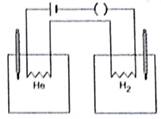
Figure shows two vessels with adiabatic walls, one containing 0.1g of helium (γ = 1.67, M = 4 g mol–1) and the other containing some amount of hydrogen (γ= 1.4, M = 2g mol–1). Initially, the temperatures of the two gases are equal. The gases are electrically heated for some time during which equal amounts of heat are given to the two gases. It is found that the temperatures rise through the same amount in the two vessels. Calculate the mass of hydrogen.