Q31 of 65 Page 77

An adiabatic cylindrical tube of cross-sectional area 1 cm2 is closed at one end and fitted with a piston at the other end. The tube contains 0.03g of an ideal gas. At 1 atm pressure and at the temperature of the surrounding, the length of the gas column is 40 cm. The piston is suddenly pulled out to double the length of the column. The pressure f the gas falls to 0.355 atm. Find the speed of sound in the gas at atmospheric temperature.


Given:


An adiabatic cylindrical tube of cross-sectional area 1 cm2 is closed at one end and fitted with a piston at the other end.


The tube contains 0.03g of an ideal gas at 1 atm pressure and at the temperature of the surrounding.


The length of the gas column is 40 cm.


The piston is suddenly pulled out to double the length of the column and the pressure of the gas falls to 0.355 atm.


The expansion process of the gas is adiabatic, so Where, subscript 1 and 2 represent the initial and the final state.


When the length is increased to double the volume is also doubled.


So,



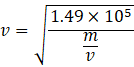
The speed of sound in gas at atmospheric pressure is given as


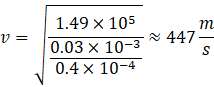
where γ is the adiabatic constant, P is pressure and ρ is the volume density. The speed is


More from this chapter

All 65 →
29

Two vessels A and B of equal volume V0 are connected by a narrow tube which can be closed by a valve. The vessels are fitted with pistons which can be moved to change the volumes. Initially, the valve is open and the vessels contain an ideal gas (CP/CV = γ) at atmospheric pressure p0 and atmospheric temperature T0. The walls of the vessel A are diathermic and those of B are adiabatic. The valve is now closed and the pistons are slowly pulled out to increase the volumes of the vessels to double the original value.

(a) Find the temperatures and pressures in the two vessels.


(b) The valve is now opened for sufficient time so that the gases acquire a common temperature and pressure. Find the new values of the temperature and the pressure.


30

Figure shows an adiabatic cylindrical tube of volume V0 divided in two parts by a frictionless adiabatic separator. Initially, the separator is kept in the middle, an ideal gas at pressure p1 and temperature T1 is injected into the left part and another ideal gas at pressure p2 and temperature T2 is injected into the right part. CP/CV = γ is the same for both the gases. The separator is slid slowly and is released at a position where it can stay in equilibrium. Find

(a) the volumes of the two parts,


(b) the heat given to the gas in the left part


(c) the final common pressure of the gases.


32

The speed of sound in hydrogen at 0°C is 1280 m s–1. The density of hydrogen at STP is 0.089 kg m–3. Calculate the molar heat capacities CP and CV of hydrogen.

33

4.0 g of helium occupies 22400 cm3 at STP. The specific heat capacity of helium at constant pressure is 5.0 cal K–1 mol–1. Calculate the speed of sound in helium at STP.