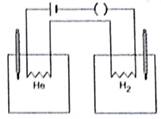
Two vessels A and B of equal volume V0 are connected by a narrow tube which can be closed by a valve. The vessels are fitted with pistons which can be moved to change the volumes. Initially, the valve is open and the vessels contain an ideal gas (CP/CV = γ) at atmospheric pressure p0 and atmospheric temperature T0. The walls of the vessel A are diathermic and those of B are adiabatic. The valve is now closed and the pistons are slowly pulled out to increase the volumes of the vessels to double the original value.
(a) Find the temperatures and pressures in the two vessels.
(b) The valve is now opened for sufficient time so that the gases acquire a common temperature and pressure. Find the new values of the temperature and the pressure.
Given:
Two vessels A and B of equal volume V0 are connected by a narrow tube which can be closed by a valve.
Vessels contain an ideal gas ( ) at atmospheric pressure p0 and atmospheric temperature T0.
The walls of the vessel A are diathermic and those of B are adiabatic.
The pistons are slowly pulled out to increase the volumes of the vessels to double the original value.
(a) As the pistons are moved slowly to increase the volume, the expansion of gas in the diathermic vessel will be an isothermic process thus the temperature will be fixed at T0. P,V and T represent the pressure, volume and temperature of the gasses and subscripts 1 and 2 denote initial and final state respectively.
Thus,

⇒ 
⇒ 
For the adiabatic vessel,

⇒ 
⇒ 
Again for ideal gasses, 
⇒ 
⇒ 
Thus the temperature and pressure in the diathermic vessel will T0 and P0/2 and in the adiabatic vessel, and
and  .
.
(b) When the valve is open, the temperature will remain T0 throughout. Thus, there will be no change in temperature in the diathermic vessel so there will be change in pressure as well. For the gas in the diathermic vessel,
 and for the adiabatic vessel
Therefore 
Again, 
Thus, 
Thus the final temperature, when the valve is open will be T0 and the final pressure will be  .
.
Couldn't generate an explanation.
Generated by AI. May contain inaccuracies — always verify with your textbook.