Q28 of 65 Page 77

Figure shows two vessels with adiabatic walls, one containing 0.1g of helium (γ = 1.67, M = 4 g mol–1) and the other containing some amount of hydrogen (γ= 1.4, M = 2g mol–1). Initially, the temperatures of the two gases are equal. The gases are electrically heated for some time during which equal amounts of heat are given to the two gases. It is found that the temperatures rise through the same amount in the two vessels. Calculate the mass of hydrogen.


Given:


Two vessels with adiabatic walls, one contains 0.1g of helium (γ = 1.67, M = 4 g mol–1) and the other contains some amount of hydrogen (γ= 1.4, M = 2g mol–1)


The gasses are given the same amount of heat.


The temperature rises through the same amount.


0.1g of helium = 0.1/4 mole = 0.025mole


Let there be n moles of hydrogen in the other vessel.


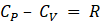
= and so,


As the vessels are of constant volume there will be no work done by the gasses. The heat supplied will totally be used to increase internal energy.


Therefore, where Q is the heat supplied, n is the number of moles, Cv is the specific heat capacity of gas at constant volume, T is the change in temperature.


For helium,


For hydrogen, we assume for both cases the rise of temperature is T.


As per question,


n = 0.015


Again, Molar mass of hydrogen = 2g mol–1


Therefore, 0.015 mole of hydrogen hydrogen


Thus, there is 0.03g of hydrogen in the vessel.


More from this chapter

All 65 →
26

Figure shows a cylindrical tube with adiabatic walls and fitted with an adiabatic separator. The separator can be slid into the tube by an external mechanism. An ideal gas (γ= 1.5) is injected in the two aides at equal pressures and temperatures. The separator remains in equilibrium at the middle. It is now slid to a position where it divides the tube in the ratio 1 : 3. Find the ratio of the temperatures in the two parts of the vessel.


27

Figure shows two rigid vessels A and B, each of volume 200 cm3 containing an ideal gas (CV = 12.5 J K–1 mol–1). The vessels are connected to a manometer tube containing mercury. The pressure in both the vessels is 75 cm of mercury and the temperature is 300 K.

(a) Find the number of moles of the gas in each vessel.


(b) 5.0 J of heat is supplied to the gas in the vessel A and 10 J to the gas in the vessel B. Assuming no appreciable transfer of heat from A to B calculate the difference in the heights of mercury in the two sides of the manometer. Gas constant R = 8.3 J K–1 mol–1.


29

Two vessels A and B of equal volume V0 are connected by a narrow tube which can be closed by a valve. The vessels are fitted with pistons which can be moved to change the volumes. Initially, the valve is open and the vessels contain an ideal gas (CP/CV = γ) at atmospheric pressure p0 and atmospheric temperature T0. The walls of the vessel A are diathermic and those of B are adiabatic. The valve is now closed and the pistons are slowly pulled out to increase the volumes of the vessels to double the original value.

(a) Find the temperatures and pressures in the two vessels.


(b) The valve is now opened for sufficient time so that the gases acquire a common temperature and pressure. Find the new values of the temperature and the pressure.


30

Figure shows an adiabatic cylindrical tube of volume V0 divided in two parts by a frictionless adiabatic separator. Initially, the separator is kept in the middle, an ideal gas at pressure p1 and temperature T1 is injected into the left part and another ideal gas at pressure p2 and temperature T2 is injected into the right part. CP/CV = γ is the same for both the gases. The separator is slid slowly and is released at a position where it can stay in equilibrium. Find

(a) the volumes of the two parts,


(b) the heat given to the gas in the left part


(c) the final common pressure of the gases.