
The graph below shows species –area relationship.

(A) If b denotes the relationship on log scale
i) Describe a and b.
ii) How is slope represented? Give the normal range of slope. iii) What kind of slope will be observed for frugivorous birds and mammals in a tropical forest?
(B) Species diversity of plants (22%) is much less than that of animals (72%). Analyze the reasons for greater diversity of animals as compared to plants.
OR
(a) Which of the above represents the increase or decrease of population?
(b) If N is the population density at time t, then what would be its density at time? Give the formula.
(c) In a barn there were 30 rats. 5 more rats enter the barn and 6 out of the total rats were eaten by the cats. If 8 rats were born during the time period under consideration and 7 rats left the barn, find out the resultant population at time.
(d) If a new habitat is just being colonized, out of the four factors affecting the population growth which factor contributes the most?
i) a: S=CAz
b: log S = log C+ Z log A
where,
S= Species richness A= Area
Z = slope of the line (regression coefficient)
C = Y-intercept
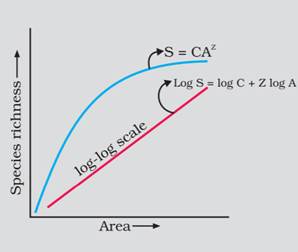
ii) Slope is represented by Z which is the regression coefficient. The normal range of slope is 0.6-1.2
iii) For Frugivorous birds the slope Z would be 1.15.
(B)
1. Animals can move hence can avoid predators and move to a more favorable spot.
2. They have well developed nervous system. They can respond to stimuli in a far better manner.
OR
(a) Label ‘a’ and ‘d’ represent increase in population.
Label ‘b’ and ‘c’ represent decrease in population.
(b) If N is the population density at time t, then density would be:
N t+1 = N t + [(B + I)- (D + E)]
(c) We have,
N t=30;
I=5;
E=7
D=6
B=8
Putting the value in
N t+1 = N t + [(B+I) - (D + E)] N t+1
=30+ [(8+5)-(6+7)] =30+ [13-13]
=30+0
=30 rats
(d) The four factors which affect population growth are:
1. Birth rate
2. Mortality rate
3. Immigartion
4. Emmigration
If a new habitat is just being colonized, out of the four factors Immigration (is the movement of people in the colony) affecting the population growth factor contributes the most
Couldn't generate an explanation.
Generated by AI. May contain inaccuracies — always verify with your textbook.

