Q21 of 63 Page 114

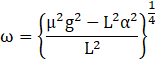
A block of mass m is kept on a horizontal ruler. The friction coefficient between the ruler and the block is μ. The ruler is fixed at one end and the block is at a distance L from the fixed end. The ruler is rotated about the fixed end in the horizontal plane through the fixed end. (a) What can the maximum angular speed be for which the block does not slip? (b) If the angular speed of the ruler is uniformly increased from zero at an angular acceleration a, at what angular speed will the block slip?
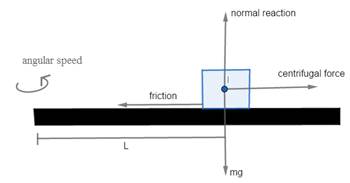

When the system rotates the block will experience centrifugal force which will be balanced by friction. Normal reaction will be balance the force of gravitation.


So,


Now


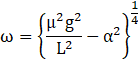
(b)


When there comes some amount of acceleration, friction starts working in the opposite direction of motion.


Here, radial acceleration will be due to centrifugal force.


The tangential acceleration will be,


It will start slipping as soon as the friction reaches its maximum value,



More from this chapter

All 63 →
19

A motorcycle has to move with a constant speed on an over-bridge which is in the form of a circular arc of radius R and has a total length L. Suppose the motorcycle starts from the highest point. (a) What can its maximum velocity be for which the contact with the road is not broken at the highest point? (b) If the motorcycle goes at speed 1/√2 times the maximum found in part (a), where will it lose the contact with the road? (c) What maximum uniform speed can it maintain on the bridge if it does not lose contact anywhere on the bridge?

20

A car goes on a horizontal circular road of radius R, the speed increasing at a constant rate The friction coefficient between the road and the tyre is μ. Find the speed at which the car will skid.

22

A track consists of two circular parts ABC and CDE of equal radius 100 m and joined smoothly as shown in figure (7-E1). Each part subtends a right angle at its center. A cycle weighing 100 kg together with the rider travels at a constant speed of 18 km/h on the track. (a) Find the normal contact force by the road on the cycle when it is at B and at D. (b) Find the force of friction exerted by the track on the Lyres when the cycle is at B, C and D. (c) Find the normal force between the road and the cycle just before and just after the cycle crosses C. (d) What should be the minimum friction coefficient between the road and the tyre, which will ensure that the cyclist can move with constant speed? Take g = 10 m/s2.


23

In a children’s park a heavy rod is pivoted at the center and is made to rotate about the pivot so that the rod always remains horizontal. Two kids hold the rod near the ends and thus rotate with the rod (figure 7-E2). Let the mass of each kid be 15 kg, the distance between the points of the rod where the two kids hold it be 30 m and suppose that the rod rotates at the rate of 20 revolutions per minute. Find the force of friction exerted by the rod on one of the kids.