Q25 of 63 Page 114

A particle is projected with a speed u at an angle θ with the horizontal. Consider a small part of its path near the highest position and take it approximately to be a circular arc. What is the radius of this circle? This radius is called the radius of curvature of the curve at the point.
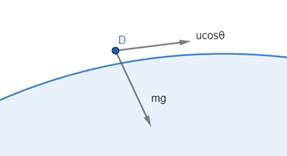

The approximation for this question will be to take gravity as a central force.


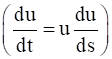
The tangential velocity in this approximated circular motion will be,


Now the central force will be,


This is the radius of the path.


More from this chapter

All 63 →
23

In a children’s park a heavy rod is pivoted at the center and is made to rotate about the pivot so that the rod always remains horizontal. Two kids hold the rod near the ends and thus rotate with the rod (figure 7-E2). Let the mass of each kid be 15 kg, the distance between the points of the rod where the two kids hold it be 30 m and suppose that the rod rotates at the rate of 20 revolutions per minute. Find the force of friction exerted by the rod on one of the kids.


24

A hemispherical bowl of radius R is rotated about its axis of symmetry which is kept vertical. A small block is kept in the bowl at a position where the radius makes an angle θ with the vertical. The block rotates with the bowl without any slipping. The friction coefficient between the block and the bowl surface is μ, Find the range of the angular speed for which the block will not slip.

26

What is the radius of curvature of the parabola traced out by the projectile in the previous problem at a point where the particle velocity makes an angle θ/2 with the horizontal?

27

A block of mass m moves on a horizontal circle against the wall of a cylindrical room of radius R. The floor of the room on which the block moves is smooth but the friction coefficient between the wall and the block is μ. The block is given an initial speed u0. As a function of the speed u write (a) the normal force by the wall on the block, (b) the frictional force by the wall and (c) the tangential acceleration of the block. (d) Integrate the tangential acceleration to obtain the speed of the block after one revolution.