Q28 of 63 Page 114

A table with smooth horizontal surface is fixed in a cabin that rotates with a uniform angular velocity ω in a circular path of radius R (figure 7-E3). A smooth groove AB of length L (<< R) is made on the surface of the table. The groove makes an angle θ with the radius OA of the circle in which the cabin rotates. A small particle is kept at the point A in the groove and is released to move along AB. Find the time taken by the particle to reach the point B.


The component of force along AB is Fccosθ where Fc is centrifugal force.
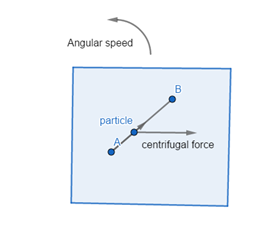


If the mass of the particle is m then the centrifugal force will be,


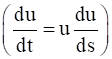
Using Newton’s 2nd law,



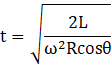
So it takes to reach the point B


More from this chapter

All 63 →
26

What is the radius of curvature of the parabola traced out by the projectile in the previous problem at a point where the particle velocity makes an angle θ/2 with the horizontal?

27

A block of mass m moves on a horizontal circle against the wall of a cylindrical room of radius R. The floor of the room on which the block moves is smooth but the friction coefficient between the wall and the block is μ. The block is given an initial speed u0. As a function of the speed u write (a) the normal force by the wall on the block, (b) the frictional force by the wall and (c) the tangential acceleration of the block. (d) Integrate the tangential acceleration to obtain the speed of the block after one revolution.

29

A car moving at a speed of 36 km/hr is taking a turn on a circular road of radius 50 m. A small wooden plate is kept on the seat with its plane perpendicular to the radius of the circular road (figure 7-E4). A small block of mass loo g is kept on the seat which rests against the plate. The friction coefficient between the block and the plate is μ = 058. (a) Find the normal contact force exerted by the plate on the block. (b) The plate is slowly turned so that the angle between the normal to the plate and the radius of the road slowly increases. Find the angle at which the block will just start sliding on the plate.


30

A table with smooth horizontal surface is placed in a cabin which moves in a circle of a large radius R (figure 7-E5). A smooth pulley of small radius is fastened to the table. Two masses m and 2m placed on the table are connected through a string going over the pulley. Initially the masses are held by a person with the strings along the outward radius and then the system is released from rest (with respect to the cabin). Find the magnitude of the initial acceleration of the masses as seen from the cabin and the tension in the string.