
A track consists of two circular parts ABC and CDE of equal radius 100 m and joined smoothly as shown in figure (7-E1). Each part subtends a right angle at its center. A cycle weighing 100 kg together with the rider travels at a constant speed of 18 km/h on the track. (a) Find the normal contact force by the road on the cycle when it is at B and at D. (b) Find the force of friction exerted by the track on the Lyres when the cycle is at B, C and D. (c) Find the normal force between the road and the cycle just before and just after the cycle crosses C. (d) What should be the minimum friction coefficient between the road and the tyre, which will ensure that the cyclist can move with constant speed? Take g = 10 m/s2.

Centrifugal forces at B and D has same magnitude but opposite direction.
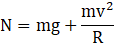
At B it is upwards. Hence normal reaction will be,
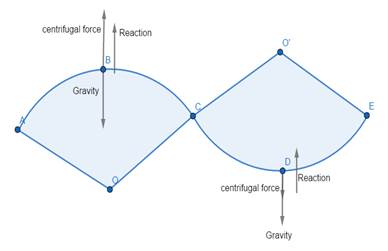



At B it is downwards. Hence normal reaction will be,


(b) 0, 707 N, 0
At points B and D the force of friction will be 0. Because there exists no force to increase the speed of the cycle by any means. So, if friction exists then the velocity will change which is against the given conditions.
At point c, there comes mgcosθ amount of force in the vertical direction. Hence friction must be equal to this force to vanish the effects.


(c) 682 N, 732 N
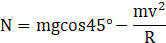
Just before, the centrifugal force will be upwards and gravity downwards.
So, normal force will be


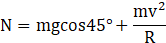
Just after, the centrifugal force will be downwards and gravity be also in downward direction.
So, normal force will be


(d) 1.037
At a point just before c is going to have the minimum friction. It will be,


Couldn't generate an explanation.
Generated by AI. May contain inaccuracies — always verify with your textbook.

