Skip to content
Philoid
Browse Saved
Back to chapter
Mathematics
5. Congruence of Triangles and Inequalities in a Triangle
Home · Class 9 · Mathematics · Ref. Book · 5. Congruence of Triangles and Inequalities in a Triangle
Prev
Next
Q11 of 97 Page 205

In ∆ABC, BD ⊥ AC and CE ⊥ AB such that BE=CD. Prove that BD=CE.

It is given that,

BD is perpendicular to AC and CE is perpendicular to AB


Now, in ∆BDC and ∆CEB we have:


BE = CD (Given)


∠BEC = ∠CDB = 90o


And, BC = BC (Common)


∴ By RHS congruence rule


∆BDC ≅ ∆CEB


BD = CE (By CPCT)


Hence, proved


More from this chapter

All 97 →
9

Prove that the perimeter of a triangle is greater than the sum of its three medians

10

Which is true?

(A) A triangle can have two acute angles.


(B) A triangle can have two right angles.


(C) A triangle can have two obtuse angles.


(D) An exterior angles of a triangle is always less than either of the interior opposite angles.

12

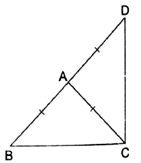
In ∆ABC, AB=AC. Side BA is produced to D such that AD=AB.

Prove that ∠BCD=90°.


13

In the given figure, it is given that AD=BC and AC=BD.

Prove that ∠CAD=∠CBD and ∠ADC=∠BCD.


Questions · 97
5. Congruence of Triangles and Inequalities in a Triangle
1 2 3 4 5 6 7 8 9 10 11 12 13 14 15 16 17 18 19 20 21 22 23 24 25 26 27 28 29 30 31 32 33 34 35 36 37 38 39 40 41 42 43 44 45 1 2 3 4 5 6 7 8 9 10 11 12 13 14 15 16 17 18 19 20 21 22 23 24 25 26 27 28 29 1 2 3 4 5 6 7 8 9 10 11 12 13 14 15 16 1 18 19 20 21 22 23
Back to chapter
ADVERTISEMENT
About Contact Privacy Terms
Philoid · 2026
  • Home
  • Search
  • Browse
  • Quiz
  • Saved