
If the sums of n terms of two arithmetic progressions are in the ratio  , then their nth terms are in the ratio
The sums of n terms of two A.P`s are in ratio 
Let a1 and d1 be the first term and common difference of the first A.P, respectively. Similarly let a2 and d2 be the common difference of the second A.P, respectively.
According to the given condition
 =
= 
 =
= 
 =
= 
Now the Nth term is given by a + (N–1) d
Equating the coefficients
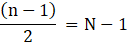
⇒ n = 2N – 1
 =
= =
=  =
= 
AI is thinking…
Couldn't generate an explanation.
Generated by AI. May contain inaccuracies — always verify with your textbook.
