Skip to content
Philoid
Browse Saved
Back to chapter
Mathematics
10. Congruent Triangles
Home · Class 9 · Mathematics · Ref. Book · 10. Congruent Triangles
Prev
Next
Q3 of 76 Page 10

BD and CE are bisectors of ∠B and ∠C of an isosceles Δ ABC with AB = BC. Prove that BD = CE.
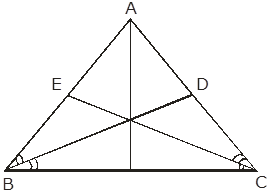

Given,


In isosceles Δ ABC,


BD and CE are bisectors of ∠B and ∠C


And,


AB = AC


To prove: BD = CE


Proof: In Δ BEC and Δ CDB, we have


∠B =∠C (Angles opposite to equal sides)


BC = BC (Common)


∠BCE = ∠CBD (Since, ∠C = ∠B ∠C = ∠B ∠BCE = ∠CBD)


By ASA theorem, we have


Δ BEC ≅ Δ CDB


EC = BD (By c.p.c.t)


Hence, proved


More from this chapter

All 76 →
1

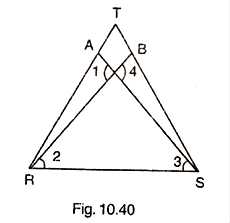
In Fig. 10.40, it is given that RT=TS, ∠1 =2∠2 and ∠4 = 2∠3. Prove that Δ RBT ≅ Δ SAT.

2

Two lines AB and CD intersect at O such that BC is equal and parallel to AD. Prove that the lines AB and CD bisect at O.

1

In two triangles one side an acute angle of one are equal to the corresponding side and angle of the other. Prove that the triangles are congruent.

2

If the bisector of the exterior vertical angle of a triangle be parallel to the base. Show that the triangle is isosceles.

Questions · 76
10. Congruent Triangles
1 2 3 4 5 6 7 8 9 10 11 12 13 1 2 3 1 2 3 4 5 6 7 8 9 10 1 2 1 2 3 4 5 6 7 1 2 3 4 5 6 7 8 9 10 11 1 2 3 4 5 6 7 8 9 10 1 2 3 4 5 6 7 8 9 10 11 12 13 14 18 16 17 18 19 20
Back to chapter
About Contact Privacy Terms
Philoid · 2026
  • Home
  • Search
  • Browse
  • Quiz
  • Saved