Q5 of 76 Page 11

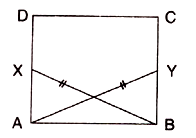
ABCD is a square, X and Y are points on sides AD and BC respectively such that AY = BX. Prove that BY = AX and BAY = ABX.


Given that ABCD is a square, X and Y are points on the sides AD and BC respectively.


Such that,


AY = BX


We have to prove: BY = AX and BAY = ABX


Join B and X, A and Y


Since, ABCD is a square


DAB = CBA = 90o


XAB = YBA = 90o (i)


Now, consider


We have,


XAB = YBA = 90o [From (i)]


BX = AY (Given)


AB = BA (Common side)


So, by RHS congruence rule, we have



(By c.p.c.t)


More from this chapter

All 76 →
3

If perpendiculars from any point within an angle on its arms are congruent, prove that it lies on the bisector of that angle.

4

In Fig. 10.99, AD CD and CB CD. If AQ=BP and DP =CQ, prove that DAQ = CBP.

6

Which of the following statements are true (T) and which are false (F):

(i) Sides opposite to equal angles of a triangle may be unequal.


(ii) Angles opposite to equal sides of a triangle are equal.


(iii) The measure of each angle of an equilateral triangle is 60°.


(iv) If the altitude from one vertex of a triangle bisects the opposite side, then the triangle may be isosceles.


(v) The bisectors of two equal angles of a triangle are equal.


(vi) If the bisector of the vertical angle of a triangle bisects the base, then the triangle may be isosceles.


(vii) The two altitudes corresponding to two equal sides of a triangle need not be equal.


(viii) If any two sides of a right triangle are respectively equal to two sides of other right triangle, then the two triangles are congruent.


(ix) Two right triangles are congruent if hypotenuse and a side of one triangle are respectively equal to the hypotenuse and a side of the other triangle.

7

Fill in the blanks in the following so that each of the following statements is true.

(i) Sides opposite to equal angles of a triangle are ………


(i) Sides opposite to equal angles of a triangle are …………..


(iii) In an equilateral triangle all angles are ……….


(iv) In a Δ ABC, if A=C, then AB = ………


(v) If altitudes CE and BF of a triangle ABC are equal, then, AB = ……..


(vi) In an isosceles triangle ABC with AB=AC, if BD and CE are its altitudes, then BD is ….CE.


(vii) In right triangles ABC and DEF, if hypotenuse AB=EF and side AC=DE, then Δ ABC Δ …….