Q18 of 79 Page 380

A thin paper of thickness 0.02 mm having a refractive index 1.45 is pasted across one of the slits in a Young’s double slit experiment. The paper transmits 4/9 of the light energy falling on it. (a) Find the ratio of the maximum intensity to the minimum intensity in the fringe pattern. (b) How many fringes will cross through the center if an identical paper piece is pasted on the other slit also? The wavelength of the light used is 600 nm.

(a)Let the original intensity of light be and that after passing from the paper be .

Given,


We know that intensities are directly proportional to the square of the amplitude. Let the initial amplitude be and that from the paper be .


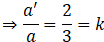
Here, k is some constant.


Therefore, and .


Now, the maximum amplitude is


And minimum amplitude is


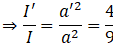
Therefore, ratio of maximum intensity to minimum is


(b)Here, the refractive index is


Wavelength of light,


Here, the optical path difference is


Therefore, the number of fringe shifts is


More from this chapter

All 79 →
16

A mica strip and a polystyrene strip are fitted on the two slits of a double slit apparatus. The thickness of the strips is 0.50 mm and the separation between the slits is 0.12 cm. The refractive index of mica and polystyrene are 1.58 and 1.55 respectively for the light of wavelength 590 nm which is used in the experiment. The interference is observed on a screen a distance one meter away. (a) What would be the fringe-width? (b) At what distance from the center will the first maximum be located?

17

Two transparent slabs having equal thickness but different refractive indices μ1 and μ2 are pasted side by side to form a composite slab. This slab is placed just after the double slit in a Young’s experiment so that the light from one slit goes through one material and the light from the other slit goes through the other material. What should be the minimum thickness of the slab so that there is a minimum at the point P0 which is equidistant from the slits?

19

A Young’s double slit apparatus has slits separated by 0.28 mm and a screen 48 cm away from the slits. The whole apparatus is immersed in water and the slits are illuminated by the red light (λ = 700 nm in vacuum). Find the fringe-width of the pattern formed on the screen.

20

A parallel beam of monochromatic light is used in a Young’s double slit experiment. The slits are separated by a distance d and the screen is placed parallel to the plane of the slits. Show that if the incident beam makes an angle with the normal to the plane of the slits, there will be a dark fringe at the center P of the pattern.