
Consider the situation shown in figure (17-E6). The two slits S1 and S2 placed symmetrically around the central line are illuminated by a monochromatic light of wavelength λ. The separation between the slits is d. The light transmitted by the slits falls on a screen ∑1 placed at a distance D from the slits. The slit S3 is at the central line and the slit S4 is at a distance z from S3. Another screen ∑2 is placed a further distance D away from ∑1. Find the ratio of the maximum to minimum intensity observed on ∑2 if z is equal to
(a) 
(b) 
(c) 

Let the intensity of slits  and
and  be
be  . The amplitude through each slit be
  .
.
For  , the phase difference is zero as it lies in the center of the screen. So here, the intensity(
 ) would be maximum.

For  , the path difference is
And the corresponding phase difference is
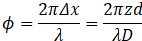
(a) For  ,
,
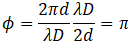
This is the condition of destructive interference, so the intensity at  is zero. Hence, only one of the slits is illuminated and so the pattern on Σ₂ would be uniform with no maxima or minima. As maxima and minima are same, the ratio is one.
(b)For  ,
,

In this case, constructive interference is taking place at  . So the intensity is maximum and is equal to
  that is
  .
.
In this case, slits  and
and  will form an interference pattern with alternate dark and bright fringes. Let the maximum intensity be
  while the minimum will be zero for a dark fringe.
Hence the ratio is  .
.
(c)For  ,
,
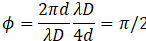
The intensity at  is thus
  .
.
And intensity at  is
is 
Let the amplitude at  be
be  and at
  be
be  .
.
Therefore,


And


So maximum amplitude at Σ₂ would be  and minimum amplitude would be
  .
.
Hence, the ratio of intensities is
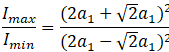

Rationalizing,

Couldn't generate an explanation.
Generated by AI. May contain inaccuracies — always verify with your textbook.

