Q31 of 79 Page 380

In a Young’s double slit experiment λ = 500 nm, d = 1.0 mm and D = 1.0 m. Find the minimum distance from the central maximum for which the intensity is half of the maximum intensity.

Given, separation between the slits

The distance between the screen and the slit,


Wavelength of light, .


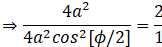
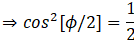
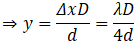
Let the maximum intensity be and the intensity at y be .


Given,


therefore, path difference,


More from this chapter

All 79 →
29

In a Young’s double slit experiment, the separation between the slits = 2.0 mm, the wavelength of the light = 600 am and the distance of the screen from the slits = 2.0 m. If the intensity at the center of the central maximum is 0.20 W m-2, what will be the intensity at a point 0.5 cm away from this center along the width of the fringes?

30

In a Young’s double slit interference experiment the fringe pattern is observed on a screen placed at a distance D from the slits. The slits are separated by a distance d and are illuminated by monochromatic light of wavelength λ. Find the distance from the central point where the intensity falls to (a) half the maximum, (b) one fourth of the maximum.

32

The line-width of a bright fringe is sometimes defined as the separation between the points on the two sides of the central line where the intensity falls to half the maximum. Find the line-width of a bright fringe in a Young’s double slit experiment in terms of λ. d and D where the symbols have their usual meanings.

33

Consider the situation shown in figure (17-E6). The two slits S1 and S2 placed symmetrically around the central line are illuminated by a monochromatic light of wavelength λ. The separation between the slits is d. The light transmitted by the slits falls on a screen ∑1 placed at a distance D from the slits. The slit S3 is at the central line and the slit S4 is at a distance z from S3. Another screen ∑2 is placed a further distance D away from ∑1. Find the ratio of the maximum to minimum intensity observed on ∑2 if z is equal to

(a)


(b)


(c)