Q23 of 79 Page 380

Consider the situation of the previous problem. If the mirror reflects only 64% of the light energy falling on it, what will be the ratio of the maximum to the minimum intensity in the interference pattern observed on the screen?

Let the original intensity of light be and that after reflection be .

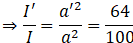
Given,


We know that intensities are directly proportional to the square of the amplitude. Let the initial amplitude be and that after reflection be .


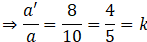
Here, k is some constant.


Therefore, and .


Now, the maximum amplitude is


And minimum amplitude is


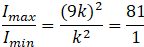
Therefore, ratio of maximum intensity to minimum is


More from this chapter

All 79 →
21

A narrow slit S transmitting light of wavelength λ is placed a distance d above a large plane mirror as shown in figure (17-E1). The light coming directly from the slit and that coming after the reflection interfere at a screen ∑ placed at a distance D from the slit. (a) What will be the intensity at a point just above the mirror, i.e., just above O’ (b) At what distance from O does the first maximum occur?


22

A long narrow horizontal slit is placed 1 mm above a horizontal plane mirror. The interference between the light coming directly from the slit and that after reflection is seen on a screen 1.0 m away from the slit. Find the fringe-width if the light used has a wavelength of 700 nm.

24

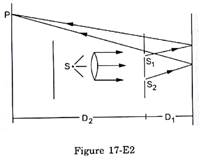
A double slit S1 - S2 is illuminated by a coherent light of wavelength λ. The slits are separated by a distance d. A plane mirror is placed in front of the double slit, at a distance D1 from it and a screen ∑ is placed behind the double slit at a distance D2 from it (figure 17-E2). The screen ∑ receives only the light reflected by the mirror. Find the fringe-width of the interference pattern on the screen.


25

White coherent light (400 nm—700 nm) is sent through the slits of a Young’s double slit experiment (figure 17-E3). The separation between the slits is 0.5 mm and the screen is 50 cm away from the slits. There is a hole in the screen at a point 1.0 mm away (along the width of the fringes) from the central line. (a) Which wavelength(s) will be absent in the light coming from the hole? (b) which wavelength(s) will have a strong intensity?