Skip to content
Philoid
Browse Saved
Back to chapter
Mathematics
15. Areas of Parallelograms
Home · Class 9 · Mathematics · Ref. Book · 15. Areas of Parallelograms
Prev
Next
Q15 of 77 Page 15

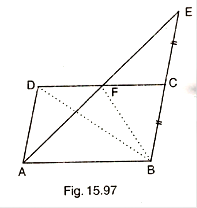
ABCD is a parallelogram in which BC is produced to E such that CE=BC. AE intersects CD at F.

(i) Prove that ar(Δ ADF) = ar(Δ ECF)


(ii) If the area of Δ DFB=3 cm2, find the area of ||gm ABCD.

In ADF and ECF

We have,


∠ADF = ∠ECF


AD = EC


And,


∠DFA = ∠CFA


So, by AAS congruence rule,


Δ ADF ≅ Δ ECF


Area (ΔADF) = Area (ΔECF)


DF = CF


BF is a median in ΔBCD


Area (ΔBCD) = 2 Area (ΔBDF)


Area (ΔBCD) = 2 * 3


= 6cm2


Hence, Area of parallelogram ABCD = 2 Area (ΔBCD)


= 2 * 6


= 12 cm2


More from this chapter

All 77 →
13

A point D is taken on the side BC of a Δ ABC such that BD = 2DC. Prove that

ar(Δ ABD) = 2ar(Δ ADC)

14

ABCD is a parallelogram whose diagonals intersect at O. If P is any point on BO, prove that

(i) ar(Δ ADO) = ar(Δ CDO)


(ii) ar(Δ ABP) = ar(Δ CBP)

16

ABCD is a parallelogram whose diagonals AC and BD intersect at O. A line through O intersects AB at P and DC at Q. Prove that

ar(Δ POA) = ar(Δ QOC)

17

ABCD is a parallelogram. E is a point on BA such that BE = 2 EA and F is a point on DC, such that DF=2FC. Prove that AE CF is a parallelogram whose area is one third of the area of parallelogram ABCD.

Questions · 77
15. Areas of Parallelograms
1 1 2 3 4 1 2 3 4 5 6 7 8 9 10 11 12 13 14 15 16 17 18 19 20 21 22 23 24 25 26 27 28 29 30 1 2 3 4 5 6 7 8 9 10 1 2 3 4 5 6 7 8 9 10 11 12 13 14 15 16 17 18 19 20 21 22 23 24 25 26 27 28 29 30 31 32
Back to chapter
About Contact Privacy Terms
Philoid · 2026
  • Home
  • Search
  • Browse
  • Quiz
  • Saved