Q6 of 52 Page 24

Read the bar graph shown in Fig. 23.10 and answer the following questions:


(i) What is the information given by the bar graph?


(ii) What was the number of commercial banks in 1977?


(iii) What is the ratio of the number of commercial banks in 1969 to that in 1980?


(iv) State whether true of false:


The number of commercial banks in 1983 is less than double the number of commercial banks in 1969.

(i) Given bar graph represents the number of commercial banks in India during some years.

(ii) The number of commercial banks in 1977 was 130


(iii) The ratio of the number of commercial banks in 1969 to the number of commercial banks in 1980 =


= 3:5


(iv) The number of commercial banks in 1983 = 230


The number of commercial banks in 1980 = 150


Clearly, the number of commercial banks in 1983 is not less than double the number of commercial banks in 1969


So, the given statement is false.


More from this chapter

All 52 →
4

Read the graph shown in Fig. 23.8 and answer the following questions:


(i) What is the information given by the bar graph?


(ii) How many tickets of Assam State Lottery were sold by the agent?


(iii) Of which state, were the maximum number of tickets sold?


(iv) State whether true or False?


The maximum number of tickets sold is three times the minimum number of tickets sold.


(v) Of which state were the minimum number of tickets sold?

5

Study the bar graph representing the number of persons in various age groups in a town shown in Fig. 23.9. Observe the bar graph and answer the following questions:


(i) What is the percentage of the youngest age-group persons over those in the oldest age group?


(ii) What is the total population of the town?


(iii) What is the number of persons in the age-group 60-65?


(iv) How many persons are more in the age-group 10-15 than in the age group 30-35?


(v) What is the age-group of exactly 1200 persons living in the town?


(vi) What is the total number of persons living in the town in the age-group 50-55?


(vii) What is the total number of persons living in the town in the age-groups 10-15 and 60-65?


(viii) Whether the population in general increases, decreases or remains constant with the increase in the age-group.

7

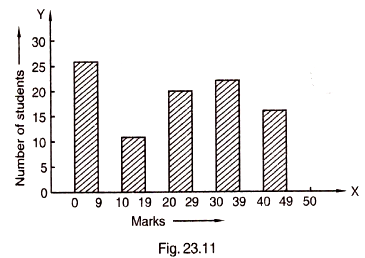
Given below (Fig. 23.11) is the bar graph indicating the marks obtained out of 50 in mathematics paper by 100 students. Read the bar graph and answer the following questions:


(i) It is decided to distribute work books on mathematics to the students obtaining less than 20 marks, giving one work book to each of such students. If a work book costs Rs. 5, what sum is required to buy the work books?


(ii) Every student belonging to the highest mark group is entitled to get a prize of Rs. 10. How much amount of money is required for distributing the prize money?


(iii) Every student belonging to the lowest mark-group has to solve 5 problems per day. How many problems, in all, will be solved by the students of this group per day?


(iv) State whether true or False:


(a) 17% students have obtained marks ranging from 40 to 40.


(b) 59 students have obtained marks ranging from 10 to 29.


(v) What is the number of students getting less than 20 marks?


(vi) What is the number of students getting more than 29 marks?


(vii) What is the number of students getting marks between 9 and 40?


(viii) What is the number of belonging to the highest mark group?


(ix) What is the number of students obtaining more than 19 marks?

8

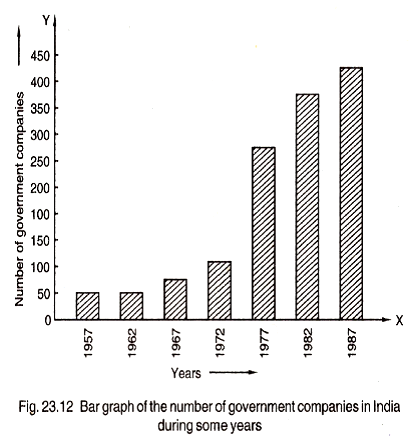
Read the following bar graph (Fig. 23.12) and answer the following questions:


(i) What is the information given by the bar graph?


(ii) State each of the following whether true or False?


(a) The number of government companies in 1957 is that of 1982 is 1: 9.


(b) The number of government companies have decreased over the year 1957 to 1983.