Q9 of 52 Page 24

Read the following bar graph and answer the following questions:


(i) What information is given by the bar graph?


(ii) Which state is the largest producer of rice?


(iii) Which state is the largest producer of wheat?


(iv) Which state has total production of rice and wheat as its maximum?


(v) Which state has the total production of wheat and rice minimum?

(i) The given information is about rice and wheat production in various states of India.

(ii) West Bengal is the largest producer of rice.


(iii) Uttar Pradesh is the largest producer of wheat.


(iv) The largest production of rice and wheat is in Uttar Pradesh.


(v) The total production of rice and wheat is minimum in Maharashtra.


More from this chapter

All 52 →
7

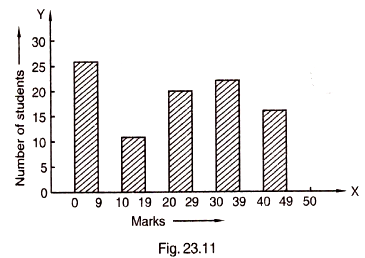
Given below (Fig. 23.11) is the bar graph indicating the marks obtained out of 50 in mathematics paper by 100 students. Read the bar graph and answer the following questions:


(i) It is decided to distribute work books on mathematics to the students obtaining less than 20 marks, giving one work book to each of such students. If a work book costs Rs. 5, what sum is required to buy the work books?


(ii) Every student belonging to the highest mark group is entitled to get a prize of Rs. 10. How much amount of money is required for distributing the prize money?


(iii) Every student belonging to the lowest mark-group has to solve 5 problems per day. How many problems, in all, will be solved by the students of this group per day?


(iv) State whether true or False:


(a) 17% students have obtained marks ranging from 40 to 40.


(b) 59 students have obtained marks ranging from 10 to 29.


(v) What is the number of students getting less than 20 marks?


(vi) What is the number of students getting more than 29 marks?


(vii) What is the number of students getting marks between 9 and 40?


(viii) What is the number of belonging to the highest mark group?


(ix) What is the number of students obtaining more than 19 marks?

8

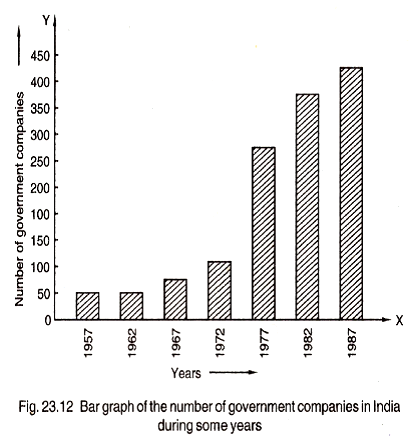
Read the following bar graph (Fig. 23.12) and answer the following questions:


(i) What is the information given by the bar graph?


(ii) State each of the following whether true or False?


(a) The number of government companies in 1957 is that of 1982 is 1: 9.


(b) The number of government companies have decreased over the year 1957 to 1983.

10

The following bar graph (Fig. 23.14) represents the heights (in cm) of 50 students of Class XI of a particular school. Study the graph and answer the following questions:


(i) What percentage of the total number of students have their heights more than 149 cm?


(ii) How many students in the class are in the range of maximum height of the class?


(iii) The school wants to provide a particular type of tonic to each student below the height of 150 cm to improve his height. If the cost of the tonic for each student comes out to be Rs. 55, how much amount of money is required?


(iv) How many students are in the range of shortest height of the class?


(v) State whether true or False:


(a) There are 9 students in the class whose heights are in the range of 155-159 cm.


(b) Maximum height (in cm) of a student in the class is 17.


(c) There are 29 students in the class whose heights are in the range of 145-154 cm.


(d) Minimum height (in cm) of a student is the class is in the range of 140-144 cm.


(e) The number of students in the class having their heights less than 150 cm is 12.


(f) There are 14 students each of whom has height more than 154 cm.

11

Read the following bar graph (Fig. 23.15) and answer the following questions:


(i) What information is given by the bar graph?


(ii) What was the production of cement in the year 1980-81?


(iii) What is the minimum and maximum production of cement and corresponding years?