
If P, Q and R are respectively the mid-points of sides BC, CA and AB respectively of a triangle and AD is the perpendicular from vertex A to BC, then prove that the points P, Q, R and D are cyclic.
Given that in ΔABC, P, Q and R are the mid-points of sides BC, CA and AB. Also AD ⊥ BC.
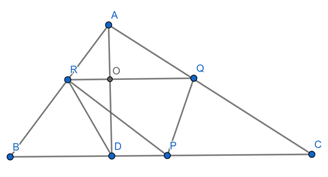
We have to prove that P, Q, R and D are concyclic.
Proof:
In ΔABC, R and Q are mid-points of AB and CA respectively.
By mid-point theorem, RQ || BC.
Also, PQ || AB and PR || CA
Consider quadrilateral BPQR,
⇒ BP ||RQ and PQ || BR
∴ BPQR quadrilateral is a parallelogram.
Similarly, ARPQ quadrilateral is a parallelogram.
We know that opposite angles of a parallelogram are equal.
⇒∠A = ∠RPQ
PR || AC and PC is the traversal,
⇒∠BPR = ∠C
⇒∠DPQ = ∠DPR + ∠RPQ = ∠A + ∠C … (1)
RQ || BC and BR is the traversal,
⇒∠ARO = ∠B … (2)
In ΔABD, R is the mid-point of AB and OR || BD.
∴ O is the mid-point of AD.
⇒ OA = OD
In ΔAOR and ΔDOR,
⇒ OA = OD
⇒∠AOR = ∠DOR = 90°
⇒ OR = OR [Common]
By SAS congruence rule,
⇒ ΔAOR ≅ Δ DRO
⇒∠ARO = ∠DRO [CPCT]
⇒∠DRO = ∠B [From (2)]
In quadrilateral PRQD,
⇒∠DRO + ∠DPQ = ∠B + (∠A + ∠C) = ∠A + ∠B + ∠C [From (1)]
Since ∠A + ∠B + ∠C = 180°,
⇒∠DRO + ∠DPQ = 180°
Hence, quadrilateral PRQD is a cyclic quadrilateral.
∴ Points P, Q, R and D are concyclic.
Hence proved.
Couldn't generate an explanation.
Generated by AI. May contain inaccuracies — always verify with your textbook.
