
The vertices A, B, C of triangle ABC have respectively position vectors  with respect to a given origin O. Show that the point D where the bisector of ∠A meets BC has position vector
  where
where  and
and 
Given the position vectors of vertices A, B and C of ΔABC are  and
and  respectively.
D is point on BC with position vector such that AD is the bisector of ∠A. I is the incenter of ΔABC.
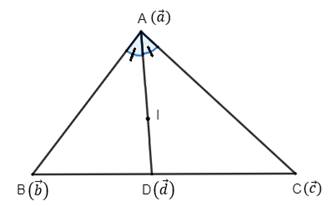
Observe from the figure that D divides BC in the ratio BD:DC.
Using the angular bisector theorem, we know that the angle bisector of an angle in a triangle bisects the opposite side in the ratio equal to the ratio of the other two sides.

But,  and
and .
.
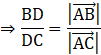
Recall the vector  is given by

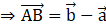
Similarly, 
So, we have  .
.
Recall the position vector of point P which divides AB, the line joining points A and B with position vectors  and
and  respectively, internally in the ratio m : n is
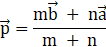
Here, we have D dividing BC internally in the ratio m:n where m = BD =  and n = DC =

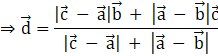
Suppose  and
and .
.
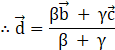
From angular bisector theorem above, we have .
.
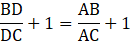
Adding 1 to both sides,
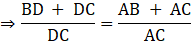
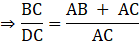
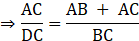
In addition, as CI is the angular bisector of ∠C in ΔACD, using the angular bisector theorem, we have
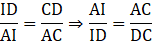
So, we get 
We have  and
and 

Assume 
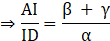
So, I divides AD in the ratio (β + γ):α.
Let the position vector of I be  .
.
Using the aforementioned section formula, we can write
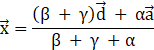
But, we already found .
.
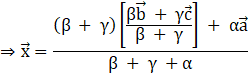
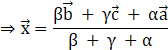
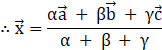
Thus,  and the position vector of the incenter is
  , where
 ,
,  and
and  .
.
Couldn't generate an explanation.
Generated by AI. May contain inaccuracies — always verify with your textbook.


