
Show that the vectors  given
given
by  and
and  are non-coplanar. Express vector
  as a linear combination of the vectors
  and
and 
Vectors parallel to the same plane, or lie on the same plane are called coplanar vectors
The three vectors are coplanar if one of them is expressible as a linear combination of the other two.
Given that



Let




Comparing the coefficients of  ,
,  and
and  , we get
1 = 2x + y …(1)
2 = x + y …(2)
3 = 3x + y …(3)
Solving equation (1) and (2), we get
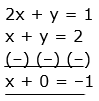
⇒ x = –1
Substitute x = –1 in equation (2), we get
2 = x + y
⇒ 2 = –1 + y
⇒ y = 2 + 1
⇒ y = 3
Put x = –1 and y = 3 in equation (3), we get
3 = 3x + y
⇒ 3 = 3(–1) + 3
⇒ 3 = –3 + 3
⇒ 3 ≠ 0
∴ L.H.S ≠ R.H.S
⇒ The value of x and y doesn’t satisfy equation (3).
Thus,  ,
,  and
and  are not coplanar.
Let  be depicted as,
 …(*)
…(*)
Substitute the value of  ,
,  ,
,  and
and  .
.



Comparing the coefficients in  ,
,  and
and  , we get
2 = x + 2y + z …(1)
–1 = 2x + y + z …(2)
–3 = 3x + 3y + z …(3)
From equation (1),
2 = x + 2y + z
⇒ z = 2 – x – 2y …(4)
Putting the value of z from equation (4) in equations (2) & (3), we get
From equation (2),
–1 = 2x + y + z
⇒ –1 = 2x + y + (2 – x – 2y)
⇒ –1 = 2x + y + 2 – x – 2y
⇒ 2x – x + y – 2y = –1 – 2
⇒ x – y = –3 …(5)
From equation (3),
–3 = 3x + 3y + z
⇒ –3 = 3x + 3y + (2 – x – 2y)
⇒ –3 = 3x + 3y + 2 – x – 2y
⇒ 3x – x + 3y – 2y = –3 – 2
⇒ 2x + y = –5 …(6)
Solving equation (5) and (6), we have

⇒ 3x = –8

Substituting  in equation (5), we get
x – y = –3
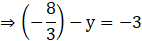
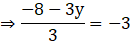
⇒ –8 – 3y = –3 × 3
⇒ –8 – 3y = –9
⇒ 3y = 9 – 8
⇒ 3y = 1

Now, substitute  and
and  in z = 2 – x – 2y, we get
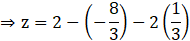
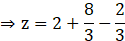
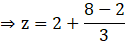
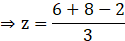


⇒ z = 4
We have got  ,
,  and z = 4.
Put these values in equation (*), we get

Thus, we have found the relation.
Couldn't generate an explanation.
Generated by AI. May contain inaccuracies — always verify with your textbook.


