
Write two basic modes of communication. Explain the process of amplitude modulation. Draw a schematic sketch showing how amplitude modulated signal is obtained by superposing a modulating signal over a sinusoidal carrier wave.
The two basic modes of communication are: -
1. Point-to-point communication
2. Broadcast communication
Amplitude Modulation: -
In this type of modulation, the message signal is super imposed on the carrier wave and the modulated wave is transmitted
The carrier wave is,

The message signal is,

So the modulated signal cm(t) can be written as,


we can write,

Here,

Is called the modulation index, Using the trigonometric relation,

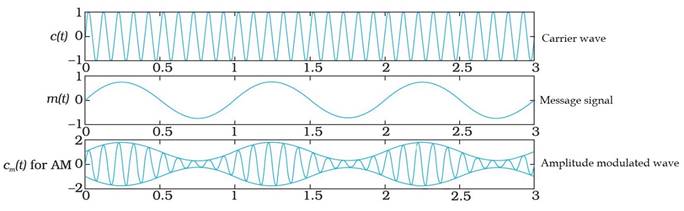 we can write,

 Here
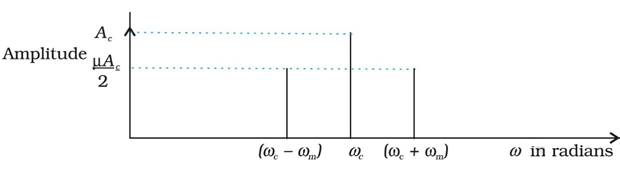
Here  and
and  are respectively called the lower side and upperside frequencies. The modulated signal now consists of thecarrier waveof frequency
  plus two sinusoidal waves each with a frequency slightly different from, known as side bands. The frequency spectrum of the amplitude modulated signal is shown below,
Couldn't generate an explanation.
Generated by AI. May contain inaccuracies — always verify with your textbook.


