
Draw a labelled diagram of Van de Graaff generator. State its working principle to show how by introducing a small charged sphere into a larger sphere, a large amount of charge can be transferred to the outer sphere. State the use of this machine and also point out its limitations.
OR
(a) Deduce the expression for the torque acting on a dipole of dipole moment  in the presence of a uniform electric field
  .
.
(b) Consider two hollow concentric spheres, S1 and S2, enclosing charges 2Q and 4Q respectively as shown in the figure.
(i) Find out the ratio of the electric flux through them.
(ii) How will the electric flux through the sphere S1 change if a medium of dielectric constant 'εr' is introduced in the space inside S1 in place of air ? Deduce the necessary expression.

Let us have a large spherical conducting shell of radius R, on which we have a charge Q. This charge spreads itself uniformly all over the sphere. As the field outside the sphere is just that of a point charge Q at the center, while the field inside the sphere vanishes. So, the potential outside is that of a point charge and inside it is constant, namely the value at the radius R. We thus have,
Potential inside conducting spherical shell of radius R carrying charge Q = constant

If anyhow we are able to introduce a small shell of radius r, carrying some charge q, into the large shell and place it at the center, the potential due to small sphere of radius r carrying charge q is,
 , at the surface of small shell,
 , at the large shell of radius R,
Thus, the total potential V and the potential difference is,
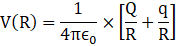
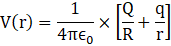
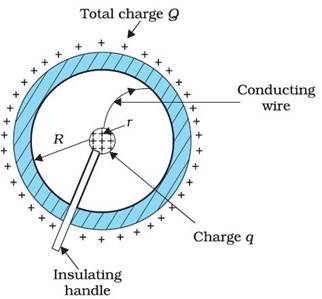
Thus,


Consider q is positive, so independent of the value of Q, the inner shell remains at higher potential and if we connect the inner and outer shell by a wire then the all the charge on outer shell will go the inner shell as it is at higher potential. This is the concept which is used to construct the Vann de Graff generator which is shown in the diagram below,
Vann de Graff generator is used to built potentials of order of few millions of volts.
The limitation of a Van de Graff generator is that it can be used only to accelerate charged particles and not neutral particles
OR
(a) Let the dipole moment be  and the electric field be,
The force acting on the charge q is q and on the charge -q is -q
 .
.
The net force on the dipole is zero as the electric field is uniform. The forces result in a torque on the dipole, which is given as,
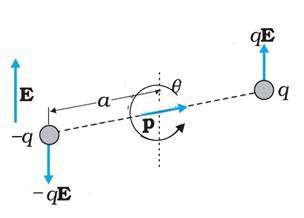
Torque, 

As The dipole moment, p= q× 2a
Where q is the charge
A is the distance between the charge
We get,

The direction of the torque is normal coming out of the plane towards the observer in accordance with right hand rule of cross product of vectors.
So,

(b)
(i) 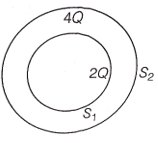
Flux through S1,
By gauss’s law,


Flux through S2,
By gauss’s law,

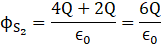
Ratio of the fluxes is

(ii) For sphere S1, the electric flux is


We get,
Φ’<Φ
When an a medium of dielectric constant εR is introduced in the space inside S1 in place of air, the new value of flux would be less with the introduction of dielectric inside.
Couldn't generate an explanation.
Generated by AI. May contain inaccuracies — always verify with your textbook.