
(i) If nP5 = 20 × nP3, find n.
(ii) If 16 × nP3 = 13 × n+1P3, find n.
(iii) If 2nP3 = 100 × nP2, find n.
(i) To find: the value of n
Formula Used:
Total number of ways in which n objects can be arranged in r places (Such that no object is replaced) is given by,
nPr
nP5 = 20 × nP3.


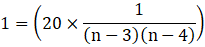
20 = (n - 3)(n - 4)


(n - 8)(n + 1) = 0
n = 8, -1
We know, that n cannot be a negative number.
Hence, value of n is 8
(ii) To find: the value of n
Formula Used:
Total number of ways in which n objects can be arranged in r places (Such that no object is replaced) is given by,
nPr
16 × nP3 = 13 × n+1P3.
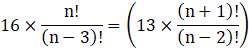

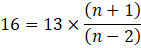
16n – 32 = 13n + 13
3n = 45
n = 15
Hence, value of n is 15.
(iii) To find: the value of n
Formula Used:
Total number of ways in which n objects can be arranged in r places (Such that no object is replaced) is given by,
nPr
2nP3 = 100 nP2
nP2
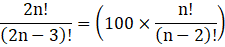


2n(2n - 1)(2n - 2) = 100 × n(n - 1)
4n(2n - 1)(n - 1) = 100 × n(n-1)


8n(n - 13) = 0
n = 0, 13
We know that n should be greater than zero.
Hence, value of n is 13
Couldn't generate an explanation.
Generated by AI. May contain inaccuracies — always verify with your textbook.