
The descending pulley shown in figure (10-E7) has a radius 20 cm and moment of inertia 0.20 kg-m2. The fixed pulley is light and the horizontal plane frictionless. Find the acceleration of the block if its mass is 1.0 kg.

The acceleration of the mass if 1 kg is 
Given
The blocks are of “m” and “M” masses, with radius of r pulley and moment of Inertia “I”
Formula Used
The formula used to find the acceleration of the mass pulled/pushed is determined by the second law of Newton when the Force/Tension applied is equivalent to the product of mass and acceleration

where
 is the force of the mass in terms of tension,
  is the acceleration and m is the mass of the block.
Explanation
The diagram 10-E7.1 as drawn below shows the tension horizontal as T’ and tension pulling the pulley as T which gives us the diagram as
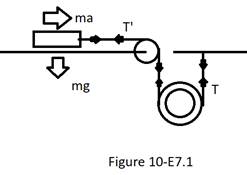
The tension in terms of acceleration due to horizontal tension is


The angular acceleration of the pulley is given as
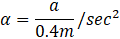
Hence, the torque applied by the pulley due to the mass is given as




Now finding the moment of Inertia we get the value of the mass M as


Putting the value of mass in tension equation, we get the equation of acceleration in terms of tension as

Again, putting the value of  , we get



Couldn't generate an explanation.
Generated by AI. May contain inaccuracies — always verify with your textbook.

