Q62 of 149 Page 195

Two small balls A and B, each of mass m, are joined rigidly by a light horizontal rod of length L. The rod is clamped at the center in such a way that it can rotate freely about a vertical axis through its center. The system is rotated with an angular speed ω about the axis. A particle P of mass m kept at rest sticks to the ball A as the ball collides with it. Find the new angular speed of the rod.
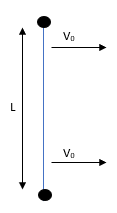

Given:


Mass of each ball = m


Length of the rod = L


Angular speed of the system =


External torque = 0


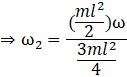
Therefore,


Hence,


More from this chapter

All 149 →
60

A uniform rod of length L lies on a smooth horizontal table. A particle moving on the table strikes the rod perpendicularly at an end and stops. Find the distance travelled by the center of the rod by the time it turns through a right angle. Show that if the mass of the rod is four times that of the particle, the collision is elastic.

61

Suppose the particle of the previous problem has a mass m and a speed u before the collision and it sticks to the rod after the collision. The rod has a mass M. (a) Find the velocity of the center of mass C of the system constituting “the rod plus the particle”. (b) Find the velocity of the particle with respect to C before the collision. (c) Find the velocity of the rod with respect to C before the collision. (d) Find the angular momentum of the particle and of the rod about the center of mass C before the collision. (e) Find the moment of inertia of the system about the vertical axis through the center of mass C after the collision. (f) Find the velocity of the center of mass C and the angular velocity of the system about the center of mass after the collision.

63

Two small balls A and B, each of mass m, are joined rigidly to the ends of a light rod of length L (figure 10-E10). The system translates on a frictionless horizontal surface with a velocity in a direction perpendicular to the rod. A particle P of mass m kept at rest on the surface sticks to the ball A as the ball collides with it. Find

(a) the linear speeds of the balls A and B after the collision, (b) the velocity of the center of mass C of the system A + B + P and (c) the angular speed of the system about C after the collision.


[Hint: The light rod will exert a force on the ball B only along its length.]


64

Suppose the rod with the balls A and B of the previous problem is clamped at the center in such a way that it can rotate freely about a horizontal axis through the clamp. The system is kept at rest in the horizontal position. A particle P of the same mass m is dropped from a height h on the ball B. The particle collides with B and sticks to it. (a) Find the angular momentum and the angular speed of the system just after the collision. (b) What should be the minimum value of h so that the system makes a full rotation after the collision.