Q64 of 149 Page 195

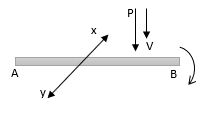
Suppose the rod with the balls A and B of the previous problem is clamped at the center in such a way that it can rotate freely about a horizontal axis through the clamp. The system is kept at rest in the horizontal position. A particle P of the same mass m is dropped from a height h on the ball B. The particle collides with B and sticks to it. (a) Find the angular momentum and the angular speed of the system just after the collision. (b) What should be the minimum value of h so that the system makes a full rotation after the collision.

Given:


Mass of particle P = m


Height from which it is dropped = h


Velocity of the particle P before collision with B=


Consider the bodies of particle P and ball B as a single system


Net external torque acting on the system is zero


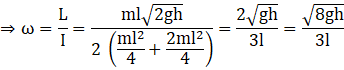
after the collision, the angular momentum of the rod
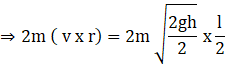


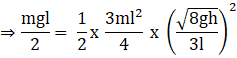
(B) When mass 2m is at top of the rod and mass m is at the bottom, the rod will rotate automatically. The total potential energy will be given as


Therefore,


More from this chapter

All 149 →
62

Two small balls A and B, each of mass m, are joined rigidly by a light horizontal rod of length L. The rod is clamped at the center in such a way that it can rotate freely about a vertical axis through its center. The system is rotated with an angular speed ω about the axis. A particle P of mass m kept at rest sticks to the ball A as the ball collides with it. Find the new angular speed of the rod.

63

Two small balls A and B, each of mass m, are joined rigidly to the ends of a light rod of length L (figure 10-E10). The system translates on a frictionless horizontal surface with a velocity in a direction perpendicular to the rod. A particle P of mass m kept at rest on the surface sticks to the ball A as the ball collides with it. Find

(a) the linear speeds of the balls A and B after the collision, (b) the velocity of the center of mass C of the system A + B + P and (c) the angular speed of the system about C after the collision.


[Hint: The light rod will exert a force on the ball B only along its length.]


65

Two blocks of masses 400 g and 200 g are connected through a tight string going over a pulley which is free to rotate about its axis. The pulley has a moment of inertia 1.6 × 10⁻⁴kg-m2 and a radius 2.0 cm. Find (a) the kinetic energy of the system as the 400 g block falls through 50 cm, (b) the speed of the blocks at this instant.

66

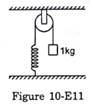
The pulley shown in figure (10-E11) has a radius of 20 cm and moment of inertia 0.2 kg-m2. The string going over it is attached at one end to a vertical spring of spring constant 50 N/m fixed from below, and supports a 1 kg mass at the other end, the system is released from rest with the spring at its natural length. Find the speed of the block when it has descended through 10 cm. Take g= 10 m/s2.