Q66 of 149 Page 195

The pulley shown in figure (10-E11) has a radius of 20 cm and moment of inertia 0.2 kg-m2. The string going over it is attached at one end to a vertical spring of spring constant 50 N/m fixed from below, and supports a 1 kg mass at the other end, the system is released from rest with the spring at its natural length. Find the speed of the block when it has descended through 10 cm. Take g= 10 m/s2.

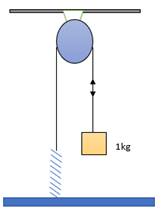

Given:


Moment of inertia (I) = 0.2 kg-m2


Radius of the pulley (r)= 20cm


Spring constant (K)= 50 N/m


Mass of the block (m)= 1 kg


Height from which it starts descends (h)= 10cm


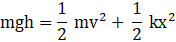
using law of conservation of the energy


More from this chapter

All 149 →
64

Suppose the rod with the balls A and B of the previous problem is clamped at the center in such a way that it can rotate freely about a horizontal axis through the clamp. The system is kept at rest in the horizontal position. A particle P of the same mass m is dropped from a height h on the ball B. The particle collides with B and sticks to it. (a) Find the angular momentum and the angular speed of the system just after the collision. (b) What should be the minimum value of h so that the system makes a full rotation after the collision.

65

Two blocks of masses 400 g and 200 g are connected through a tight string going over a pulley which is free to rotate about its axis. The pulley has a moment of inertia 1.6 × 10⁻⁴kg-m2 and a radius 2.0 cm. Find (a) the kinetic energy of the system as the 400 g block falls through 50 cm, (b) the speed of the blocks at this instant.

67

A meter stick is held vertically with one end on a rough horizontal floor. It is gently allowed to fall on the floor. Assuming that the end at the floor does not slip, find the angular speed of the rod when it hits the floor.

68

A meter stick weighing 240 g is pivoted at its upper end in such a way that it can freely rotate in a vertical plane through this end (figure 10-E12). A particle of mass 100 g is attached to the upper end of the stick through a light string of length 1 m. Initially, the rod is kept vertical and the string horizontal when the system is released from rest. The particle collides with the lower end of the stick and sticks there. Find the maximum angle through which the stick will rise.