Q61 of 149 Page 195

Suppose the particle of the previous problem has a mass m and a speed u before the collision and it sticks to the rod after the collision. The rod has a mass M. (a) Find the velocity of the center of mass C of the system constituting “the rod plus the particle”. (b) Find the velocity of the particle with respect to C before the collision. (c) Find the velocity of the rod with respect to C before the collision. (d) Find the angular momentum of the particle and of the rod about the center of mass C before the collision. (e) Find the moment of inertia of the system about the vertical axis through the center of mass C after the collision. (f) Find the velocity of the center of mass C and the angular velocity of the system about the center of mass after the collision.


Given:


Mass of the rod= M


(a) We can take the two bodies as a single system


Hence, total external force = 0


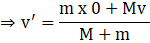
Using law of conservation of linear momentum



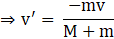
(b) Consider the velocity of the particle with respect to the center of mass =


(c) Suppose the body is moving towards the rod with the velocity v, then it means the rod is moving with a velocity -v towards the particle


Therefore, the velocity of the rod with respect to the center of mass = -v


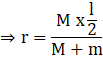
(d) The distance between the particle and the center of the mass is given as


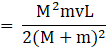
The angular momentum of the body before collision


=


=



Angular momentum of rod about center of mass


=



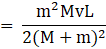
(e) Moment of inertia of the system = Momentum of inertia due to rod + momentum of inertia due to particle



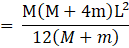


(f) The velocity of the center of mass


Also, angular momentum of center of mass


More from this chapter

All 149 →
69

A uniform rod of mass m and length l is struck at an end by a force F perpendicular to the rod for a short time interval. Calculate

(a) the speed of the center of mass, (b) the angular speed of the rod about the center of mass, (c) the kinetic energy of the rod and (d) the angular momentum of the rod about the center of mass after the force has stopped to act. Assume that t is so small that the rod does not appreciably change its direction while the force acts.


60

A uniform rod of length L lies on a smooth horizontal table. A particle moving on the table strikes the rod perpendicularly at an end and stops. Find the distance travelled by the center of the rod by the time it turns through a right angle. Show that if the mass of the rod is four times that of the particle, the collision is elastic.

62

Two small balls A and B, each of mass m, are joined rigidly by a light horizontal rod of length L. The rod is clamped at the center in such a way that it can rotate freely about a vertical axis through its center. The system is rotated with an angular speed ω about the axis. A particle P of mass m kept at rest sticks to the ball A as the ball collides with it. Find the new angular speed of the rod.

63

Two small balls A and B, each of mass m, are joined rigidly to the ends of a light rod of length L (figure 10-E10). The system translates on a frictionless horizontal surface with a velocity in a direction perpendicular to the rod. A particle P of mass m kept at rest on the surface sticks to the ball A as the ball collides with it. Find

(a) the linear speeds of the balls A and B after the collision, (b) the velocity of the center of mass C of the system A + B + P and (c) the angular speed of the system about C after the collision.


[Hint: The light rod will exert a force on the ball B only along its length.]