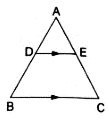
In a ΔABC, if DE is drawn parallel to BC, cutting AB and AC at D and E respectively such that AB = 7.2 cm, AC = 6.4 cm and AD = 4.5 cm. Then, AE = ?

BY Basic Proportionality Theorem:
If a line is drawn parallel to one side of a triangle to intersect the other two sides in distinct points, the other two sides are divided in the same ratio.

Or 
Adding 1 to both sides

 =
= 
 =
= 
 =
= 
AE = 4 cm
AI is thinking…
Couldn't generate an explanation.
Generated by AI. May contain inaccuracies — always verify with your textbook.