
If a, b and c are all non-zero and  , then prove that
  .
.
Let 
Given that Δ = 0.
We can write the determinant Δ as
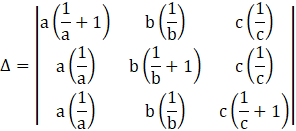
Taking a, b and c common from C1, C2 and C3, we get
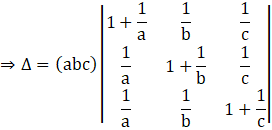
Recall that the value of a determinant remains same if we apply the operation Ri→ Ri + kRj or Ci→ Ci + kCj.
Applying C1→ C1 + C2, we get
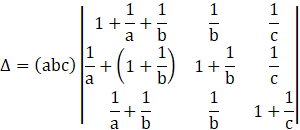
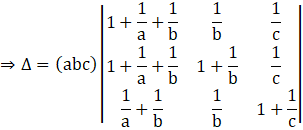
Applying C1→ C1 + C3, we get
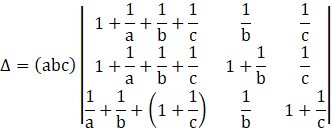
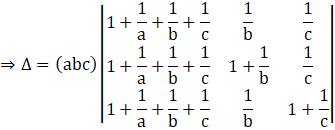
Taking common from C1, we get
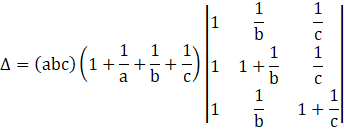
Applying R2→ R2 – R1, we get
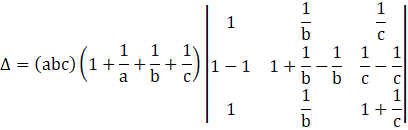
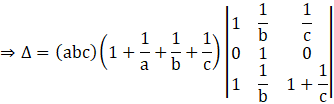
Applying R3→ R3 – R1, we get

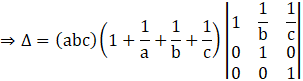
Expanding the determinant along C1, we have


We have Δ = 0.

It is given that a, b and c are all non-zero.

Thus, when
when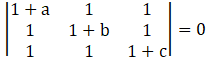 and a, b, c are all non-zero.
AI is thinking…
Couldn't generate an explanation.
Generated by AI. May contain inaccuracies — always verify with your textbook.


