
Solve the following systems of linear equations by Cramer’s rule:
5x + 7y = – 2
4x + 6y = – 3
Given: - Two equations 5x + 7y = – 2 and 4x + 6y = – 3
Tip: - Theorem – Cramer’s Rule
Let there be a system of n simultaneous linear equations and with n unknown given by





and let Dj be the determinant obtained from D after replacing the jth column by

Then,
 provided that D ≠ 0
Now, here we have
5x + 7y = – 2
4x + 6y = – 3
So by comparing with the theorem, let's find D, D1 and D2
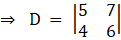
Solving determinant, expanding along 1st row
⇒ D = 5(6) – (7)(4)
⇒ D = 30 – 28
⇒ D = 2
Again,
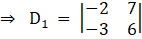
Solving determinant, expanding along 1st row
⇒ D1 = – 2(6) – (7)( – 3)
⇒ D1 = – 12 + 21
⇒ D1 = 9
and
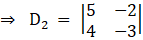
Solving determinant, expanding along 1st row
⇒ D2 = – 3(5) – ( – 2)(4)
⇒ D2 = – 15 + 8
⇒ D2 = – 7
Thus by Cramer’s Rule, we have
⇒ 
⇒ 
⇒ 
and
⇒ 
⇒ 
⇒ 
Couldn't generate an explanation.
Generated by AI. May contain inaccuracies — always verify with your textbook.