
Find the distance of the point (2, 5) from the line 3x + y + 4 = 0 measured parallel to the line 3x – 4y + 8 = 0.
Given: (x1,y1) = A(2,5)
To find:
The distance of a point from the line parallel to another line.
Explanation:
It is given that the required line is parallel to 3x −4y + 8 = 0
⇒ 4y = 3x + 8
⇒ y
∴ tanθ
⇒ sinθ , cosθ
So, the equation of the line is

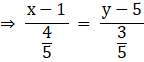
⇒ 3x – 6 = 4y – 20
⇒ 3x – 4y + 14 = 0
Let the line 3x – 4y + 14 = 0 cut the line 3x + y + 4 = 0 at P.
Let AP = r Then, the coordinates of P are given by
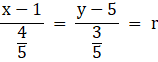
⇒ x , y
, y
Thus, the coordinates of P are 
Clearly, P lies on the line 3x + y + 4 = 0.
∴ 
⇒ 
⇒ 
⇒ r = – 5
∴ AP = |r| = 5
Couldn't generate an explanation.
Generated by AI. May contain inaccuracies — always verify with your textbook.