
Mark the correct alternative in the following:
If,  is the sum of an arithmetic progression of ‘n’ odd number of terms and
  the sum of the terms of the series in odd places, then
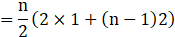
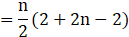
Here, First A.P is 1,3,5…
So, a=1 and d=3-1=2
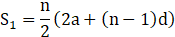
Now, sum of n term is given by,


Now, second A.P. is 1,5,9,…
In this A.P. a=1, d=5-1=4
Let us assume that total no. of term in first A.P. is even then total no. of term in second A.P. is 
Now, 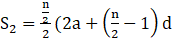
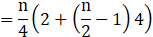
 )
)


Then 

Let us assume that total no. of term in first A.P. is odd then total no. of term in second A.P. is 
Now, 

 )
)


Then 

AI is thinking…
Couldn't generate an explanation.
Generated by AI. May contain inaccuracies — always verify with your textbook.


