Skip to content
Philoid
Browse Saved
Back to chapter
Maths
4. Triangles
Home · Class 10 · Maths · Ref. Book · 4. Triangles
Prev
Next
Q28 of 168 Page 4

If E is a point on side CA of an equilateral triangle ABC such that, then AB2 + BC + CA2 =

Given in equilateral ΔABC, BE ⊥ AC.
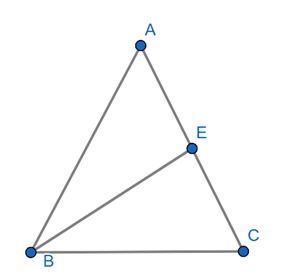


We know that in an equilateral triangle, the perpendicular from the vertex bisects the base.


∴ CE = AE = AC/2


In ΔABE,


⇒ AB2 = BE2 + AE2


Since AB = BC = AC,


⇒ AB2 = BC2 = AC2 = BE2 + AE2


⇒ AB2 + BC2 + AC2 = 3BE2 + 3AE2


Since BE is an altitude,
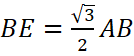


BE = √3 AE


⇒ AB2 + BC2 + AC2


= 3BE2 + BE2


∴ AB2 + BC2 + AC2 = 4BE2

More from this chapter

All 168 →
26

is a right triangle right-angled at A and . Then, =

27

If ABC is a right triangle right-angled at B and M, N are the mid-points of AB and BC respectively, then 4 (AN2 + CM2) =

29

In a right triangle ABC right-angled at B, if P and Q are points on the sides AB and AC respectively, then

30

If in and , , then when

Questions · 168
4. Triangles
1 2 1 2 3 4 5 6 7 8 1 2 3 4 5 6 7 1 1 1 1 2 3 4 5 6 7 8 9 10 11 12 13 14 15 16 17 18 19 20 21 22 23 24 25 1 2 3 4 5 6 7 8 9 10 11 12 13 14 15 16 17 18 19 20 21 22 1 2 3 4 5 6 7 8 9 10 11 12 13 14 15 16 17 18 19 20 21 22 23 24 25 26 27 28 1 2 3 4 5 6 7 8 9 10 11 12 13 14 15 16 17 18 19 20 21 22 1 2 3 4 5 6 7 8 9 10 11 12 13 14 15 16 17 18 19 20 21 22 23 24 25 26 27 28 29 30 31 32 33 34 35 36 37 38 39 40 41 42 43 44 45 46 47 48 49 50 51
Back to chapter
ADVERTISEMENT
About Contact Privacy Terms
Philoid · 2026
  • Home
  • Search
  • Browse
  • Quiz
  • Saved