Skip to content
Philoid
Browse Saved
Back to chapter
Mathematics
9. Quadrilaterals and Parallelograms
Home · Class 9 · Mathematics · Ref. Book · 9. Quadrilaterals and Parallelograms
Prev
Next
Q4 of 109 Page 330

In a ΔABC, D and E are the mid-points of AB and AC respectively and DE = 5.6 cm. Find the length of BC.

We know that in ∆ABC, D and E are the midpoints of AB and AC, respectively.

Now using mid-point theorem,


DE = (BC)


BC= 2 ⨯ DE


BC= 2 ​⨯ 5.6


= 11.2 cm


Thus, BC = 11.2 cm


More from this chapter

All 109 →
2

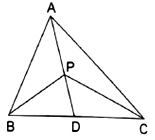
If P is a point on the median AD of a ΔABC, then ar (ΔABP) = ar(ΔACP).

3

The angles of a quadrilateral are in the ratio 1:3:5:6. Find its greatest angle.

5

In the given figure, AD is the median and DE || AB. Prove that BE is the median.

6

In the given figure, lines l, m and n are parallel lines and the lines p and q are transversals. If AB = 5 cm, BC = 15 cm, then DE : EF = ?

Questions · 109
9. Quadrilaterals and Parallelograms
1 2 3 4 5 6 7 8 9 10 1 2 3 4 5 6 7 8 9 10 11 12 13 14 15 16 17 18 19 20 21 1 2 3 4 5 6 7 8 9 10 11 12 13 1 2 3 4 5 6 7 8 9 10 11 12 13 14 15 16 17 18 19 20 21 22 23 24 25 26 27 28 29 30 31 32 33 34 35 36 37 38 39 40 41 42 43 44 45 1 2 3 4 5 6 7 8 9 10 11 12 13 14 15 16 17 18 19 20
Back to chapter
ADVERTISEMENT
About Contact Privacy Terms
Philoid · 2026
  • Home
  • Search
  • Browse
  • Quiz
  • Saved