Q8 of 67 Page 98

A steel frame (K = 45 W m–1 °C–1) of total length 60 cm and cross-sectional area 0.20 cm2, forms three sides of a square. The free ends are maintained at 20°C and 40°C. Find the rate of heat flow through a cross-section of the frame.


Given:
Thermal conductivity of steel frame: K=45 W m–1 °C–1.
Length of the steel frame : x = 60 cm = 0.6 m
Area of cross section : A = 0.20 cm2 = 0.2 × 10⁻⁴ m2.
Temperature difference between the free ends :
ΔT = 40-20= 20°C.
Formula used:
Rate of amount of heat flowing is given as:
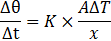
Here, Δθ is the amount of heat transferred, ΔT is the temperature difference, K is the thermal conductivity of the material, A is the area of cross section of the material and x is the thickness of the material.
Substituting the values we get,
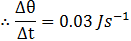

Hence, the rate of heat flow through a cross-section of the frame is 0.03 J/s.


More from this chapter

All 67 →
6

An icebox almost completely filled with ice at 0°C is dipped into a large volume of water at 20°C. The box has walls of surface area 2400 cm2, thickness 2.0 mm and thermal conductivity 0.06 W m–1 °C–1. Calculate the rate at which the ice melts in the box. Latent heat of fusion of ice = 3.4 × 10⁵ J kg–1.

7

A pitcher with 1 mm thick porous walls contains 10 kg of water. Water comes to its outer surface and evaporates at the rate of 0.1 g s–1. The surface area of the pitcher (one side) = 200 cm2. The room temperature = 45°C, latent heat of vaporization = 2.27 × 10⁶ J kg–1, and the thermal conductivity of the porous walls = 0.80 J s–1m–1 °C–1. Calculate the temperature of water in the pitcher when it attains a constant value.

9

Water at 50°C is filled in a closed cylindrical vessel of height 10 cm and cross-sectional area 10 cm2. The walls of the vessel are adiabatic but the flat parts are made of 1 mm thick aluminium (K = 200 J s–1 m–1 °C–1). Assume that the outside temperature is 20°C. The density of water is 1000 kg m–3, and the specific heat capacity of water = 4200 J k–1 m–1 °C–1. Estimate the time taken for the temperature to fall by 1.0°C. Make any simplifying assumptions you need but specify them.

10

The left end of a copper rod (length = 20 cm, area of cross-section = 0.20 cm2) is maintained at 20°C and the right end is maintained at 80°C. Neglecting any loss of heat through radiation, find

(a) the temperature at a point 11 cm from the left end and


(b) the heat current through the rod. Thermal conductivity of copper = 385 W m–1 °C–1.