Q26 of 67 Page 98

Consider the situation shown in figure. The frame is made of the same material and has a uniform cross-sectional are everywhere. Calculate the amount of heat flowing per second through a cross-section of the bent part if the total heat taken out per second from the end at 100°C is 130J.


For the above frame, redrawing the fig,


w4.PNG


(1)


The equivalent resistance network becomes –


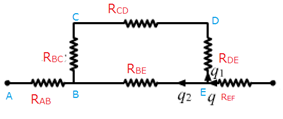
Let RAB, RBC, RCD, RDE, REF and RBE be the equivalent resistance across each cross-section as shown in fig. below –

w5.PNG


(2)


Resistance in terms of conductivity


R= (1)


From fig (1) and (2)and equation (1)


RAB = , RBC = , RCD =, RDE =, REF= and RBE =


Now, lets reduce the network into equivalent network .


Since RBC RCD RDE are connected in series, let R1 be their equivalent resistance.


Then R1 = RBC+RCD + RDE


=


=


Now the circuit reduces to –


w6.png


Now from Kirchhoff’s current law(KCL), we know The algebraic sum of all currents entering and exiting a node must equal zero


Hence ,KCL at point E , since -


q = q1 +q2


Now, since R1 and RBE are in parallel, so total heat across R1 and RBE will be same.


ie, q1R1 = q2RBE


=


q2 =


Now, q = q1 +q2


= q1 + q1


Given q = 130 J, substituting above


130 =


q1 = 60 J


More from this chapter

All 67 →
24

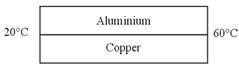
An aluminium rod and a copper rod of equal length 1.0 m and cross-sectional area 1 cm2 are welded together as shown in figure. One end is kept at a temperature of 20°C and the other at 60°C. Calculate the amount of heat taken out per second from the hot end. Thermal conductivity of aluminium = 200 Wm–1 °C–1 and of copper = 390 Wm–1 °C–1.


25

Figure shows an aluminium rod joined to a copper rod. Each of the rods has a length of 20 cm and area of cross-section 0.20 cm2. The junction is maintained at a constant temperature 40°C and the two ends are maintained at 80°C. Calculate the amount of heat taken out from the cold junction in one minute after the steady state is reached. The conductivities are KAl = 200 W m–1°C–1andKCu = 400 W m–1 °C–1.


27

Suppose the bent part of the frame of the previous problem has a thermal conductivity of 780 J s–1m–1 °C–1, whereas it is 390 J s–1m–1°C–1for the straight part. Calculate the ratio of the rate of hat flow through the bent part to the rate of heat flow through the straight part.

28

A room has a window fitted with a single 1.0 m × 2.0 m glass of thickness 2 mm.

(a) Calculate the rate of heat flow through the closed window when the temperature inside the room is 32°C and that outside is 10°C.


(b) The glass is now replaced by two glass panes, each having a thickness of 1 mm and separated by a distance of 1 mm.


Calculate the rate of heat flow under the same conditions of temperature. Thermal conductivity of window glass = 1.0 J s–1m–1 °C–1and that of air = 0.025 J s–1m–1 °C–1.