
Figure shows two adiabatic vessels, each containing a mass m of water at different temperatures. The ends of a metal rod of length L, area of cross-section A and thermal conductivity K, are inserted in the water as shown in the figure. Find the time taken for the difference between the temperatures in the vessels to become half of the original value. The specific heat capacity of water is s. Neglect the heat capacity of the rod and the container and any loss of heat to the atmosphere.

Given length of metal rod = L
specific heat capacity of water = s
Mass of water =m
Rate of transfer of heat –
 =
= 
 = is change in temperature.
A= Area of cross section of the tube
K = thermal conductivity of the tube
L= length
In time ∆t, the heat transfer from the rod will be given by
∆Q=  (1)
(1)
Now, heat loss by water at temperature T1 is equal to the heat gain by water at temperature T2
So, heat loss by water at temperature T1 in time ∆t is -
∆Q=ms(T1-T1’) (2)
Where
m = mass of water
S = specific heat of water
From (1) and (2)
⇒ ms(T1-T1’) = 
T1’=
This is the fall in temperature of water at temperature T1.
Similarly, rise in temperature of water at temperature T2
T2’=
Finally, change in temperature is given by-
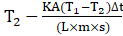
(T1’-T2’)= –
–
⇒ {(T1’-T2’)- (T1-T2)} = - 
⇒  = -
= -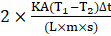
Where  is the rate of change of temperature difference.
Taking integral on both sides-
 =
= dt
dt
⇒ t =
Hence the time taken for the difference between the temperatures in the vessels to become half of the original value is
t =
Couldn't generate an explanation.
Generated by AI. May contain inaccuracies — always verify with your textbook.