Q17 of 67 Page 98

A semicircular rod is joined at its end to a straight rod of the same material and the same cross-sectional area. The straight rod forms a diameter of the other rod. The junctions are maintained at different temperatures. Fid the ratio of the heat transferred through a cross-section of the semicircular rod to the heat transferred through a cross-section of the straight rod in a given time.


Given:
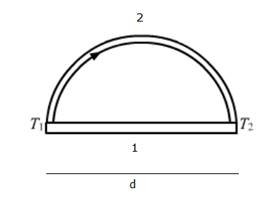
Temperature at junction 1: T1
Temperature at junction 2: T2
Length of the rod 1: x= d=2r
Where d is the diameter and r is the radius.
Length of the rod 2: x’ = circumference = πr
Formula used:
Rate of amount of heat flowing or heat current is given as:
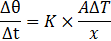
Here, Δθ is the amount of heat transferred, ΔT is the temperature difference, K is the thermal conductivity of the material, A is the area of cross section of the material and x is the thickness or length of the material.
As both the rods have same material, their thermal conductivity is the same.
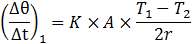
(1)
Rate of heat flowing through rod 1
(2)
Rate of heat flowing through rod 2

Ratio of the rate of heat transferred from semi circular rod to straight rod is
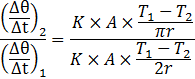


Hence, the ratio of the heat transferred through a cross-section of the semicircular rod to the heat transferred through a cross-section of the straight rod in a given time is 2:π


More from this chapter

All 67 →
15

Consider the situation of the previous problem. Assume that the temperature of the water at the bottom of the lake remains constant at 4°C as the ice forms on the surface (the heat required to maintain the temperature of the bottom layer may come from the bed of the lake). The depth of the lake is 1.0 m. Show that the thickness of the ice formed attains a steady state maximum value. Find this value. The thermal conductivity of water = 0.50 Wm–1 °C–1. Take other relevant data from the previous problem.

16

Three rods of lengths 20 cm each and area of cross-section 1 cm2 are joined to form a triangle ABC. The conductivities of the rods are KAB = 50 J s–1 m–1 °C–1, KBC = 200 J s–1 m–1 °C–1 and KAC = 400 J s–1 m–1 °C–1. The junctions A, B and C are maintained at 40°C, 80°C and 80°C respectively. Find the rate of heat flowing through the rods AB, AC and BC.

18

A metal rod of cross-sectional area 1.0 cm3 is being heated at one end. At one time, the temperature gradient is 5.0°C cm–1 at cross-section A and is 2.5°C cm–3 at cross-section B. calculate the rate at which the temperature is increasing in the part AB of the rod. The heat capacity of the part AB = 0.40 J°C–1, thermal conductivity of the material of the rod = 200 W m–1 °C–1. Neglect any loss of heat to the atmosphere.

19

Steam at 120°C is continuously passed through a 50 cm long rubber tube of inner and outer radii 1.0 cm and 1.2 cm. The room temperature is 30°C. Calculate the rate of heat flow through the walls of the tube. Thermal conductivity of rubber = 0.15 J s–1 m–1 °C–1.