Q15 of 67 Page 98

Consider the situation of the previous problem. Assume that the temperature of the water at the bottom of the lake remains constant at 4°C as the ice forms on the surface (the heat required to maintain the temperature of the bottom layer may come from the bed of the lake). The depth of the lake is 1.0 m. Show that the thickness of the ice formed attains a steady state maximum value. Find this value. The thermal conductivity of water = 0.50 Wm–1 °C–1. Take other relevant data from the previous problem.


Given:
Temperature at the bottom of the lake: T1 = 4 °C
Temperature above the surface : T2 = - 10 °C
Depth of the lake: d = 1 m
Thermal conductivity of water: KW = 0.50 Wm–1 °C–1.
Thermal conductivity of ice: KI = 1.7 W m–1 °C–1.
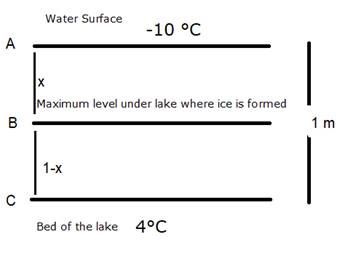

Distance AB is : xAB = x m
Distance CB is : xCB = (1-x) m
Formula used:
Rate of amount of heat flowing or heat current is given as:
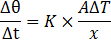
Here, Δθ is the amount of heat transferred, ΔT is the temperature difference, K is the thermal conductivity of the material, A is the area of cross section of the material and x is the thickness or length of the material.
In the diagram, point B depicts the maximum level upto which ice can be formed inside the lake.
Temperature at B : T3 = 0°C
This ice attains a steady state maximum level. Steady state means that the temperature at any point remains unchanged.
This means that the temperature difference between points A,B and C would be unchanged.

This means that the rate of heat transfer between A and B equals the rate of heat transfer between B and C.





Hence, after attaining steady state the thickness of the ice below the lake is 0.894 m.


More from this chapter

All 67 →
13

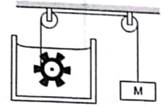
Figure shows water in a container having 2.0 mm thick walls made of a material of thermal conductivity 0.50 W m–1 °C–1. The container is kept in a melting ice bath at 0°C. The total surface area in contact with water is 0.05 m2. A wheel is clamped inside the water and is coupled to a block of mass M as shown in the figure. As the block goes down, the wheel rotates. It is found that after some time a steady state is reached in which the block goes down with a constant speed of 10 cm s–1 and the temperature of the water remains constant at 1.0°C. Find the mass M of the block. Assume that the heat flows out of the water only through the walls in contact. Take g = 10 m s–2.

14

On a winter day when the atmospheric temperature drops to –10°C, ice forms on the surface of a lake.

(a) Calculate the rate of increase of thickness of the ice when 10 cm of ice is already formed.


(b) Calculate the total time taken in forming 10 cm of ice. Assume that the temperature of the entire water reaches 0°C before the ice starts forming. Density of water = 1000 kg m–3, latent heat of fusion of ice = 3.36 × 10⁵ J kg–1 and thermal conductivity of ice = 1.7 W m–1 °C–1. Neglect the expansion of water on freezing.


16

Three rods of lengths 20 cm each and area of cross-section 1 cm2 are joined to form a triangle ABC. The conductivities of the rods are KAB = 50 J s–1 m–1 °C–1, KBC = 200 J s–1 m–1 °C–1 and KAC = 400 J s–1 m–1 °C–1. The junctions A, B and C are maintained at 40°C, 80°C and 80°C respectively. Find the rate of heat flowing through the rods AB, AC and BC.

17

A semicircular rod is joined at its end to a straight rod of the same material and the same cross-sectional area. The straight rod forms a diameter of the other rod. The junctions are maintained at different temperatures. Fid the ratio of the heat transferred through a cross-section of the semicircular rod to the heat transferred through a cross-section of the straight rod in a given time.