Q12 of 67 Page 98

A cubical box of volume 216 cm3 is made up to 0.1 cm thick wood. The inside is heated electrically by a 100 W heater. It is found that the temperature difference between the inside and the outside surface is 5°C in steady state. Assuming that the entire electrical energy spent appears as heat, find the thermal conductivity of the material of the box.


Given:
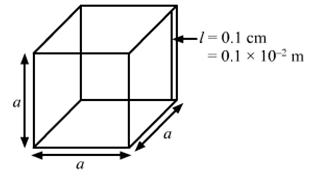
Volume of the box : V = 216 cm3 = 216× 10-6 m3.
Thickness of the box: x = 0.1 cm = 0.001 m
Power of the heater : P = 100 W
Temperature difference : ΔT = 5 °C
Formula used:
Rate of amount of heat flowing or heat current is given as:

Here, Δθ is the amount of heat transferred, ΔT is the temperature difference, K is the thermal conductivity of the material, A is the area of cross section of the material and x is the thickness or length of the material.
Volume of the cube is a3. Where a is the side of the cube.
a = (216× 10-6)1/3 = 0.06 m
As heat will be transferred from all the sides of the cube,
Surface area of the cube is : A = 6a2
A = 6× (0.06)2 = 0.0216 m2.
We know that,
Power = Energy per unit time
Thus,

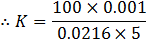
Substituting we get,


More from this chapter

All 67 →
10

The left end of a copper rod (length = 20 cm, area of cross-section = 0.20 cm2) is maintained at 20°C and the right end is maintained at 80°C. Neglecting any loss of heat through radiation, find

(a) the temperature at a point 11 cm from the left end and


(b) the heat current through the rod. Thermal conductivity of copper = 385 W m–1 °C–1.


11

The ends of a metre stick are maintained at 100°C and 0°C. One end of a rod is maintained at 25°C. Where should its other end be touched on the metre stick so that there is no heat current in the rod in steady state?

13

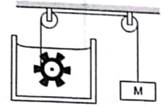
Figure shows water in a container having 2.0 mm thick walls made of a material of thermal conductivity 0.50 W m–1 °C–1. The container is kept in a melting ice bath at 0°C. The total surface area in contact with water is 0.05 m2. A wheel is clamped inside the water and is coupled to a block of mass M as shown in the figure. As the block goes down, the wheel rotates. It is found that after some time a steady state is reached in which the block goes down with a constant speed of 10 cm s–1 and the temperature of the water remains constant at 1.0°C. Find the mass M of the block. Assume that the heat flows out of the water only through the walls in contact. Take g = 10 m s–2.

14

On a winter day when the atmospheric temperature drops to –10°C, ice forms on the surface of a lake.

(a) Calculate the rate of increase of thickness of the ice when 10 cm of ice is already formed.


(b) Calculate the total time taken in forming 10 cm of ice. Assume that the temperature of the entire water reaches 0°C before the ice starts forming. Density of water = 1000 kg m–3, latent heat of fusion of ice = 3.36 × 10⁵ J kg–1 and thermal conductivity of ice = 1.7 W m–1 °C–1. Neglect the expansion of water on freezing.