Q11 of 67 Page 98

The ends of a metre stick are maintained at 100°C and 0°C. One end of a rod is maintained at 25°C. Where should its other end be touched on the metre stick so that there is no heat current in the rod in steady state?


Given:
Temperature difference between the ends of the meter stick AB:
ΔT = T2-T1 = 100-0 = 100 °C
Temperature of one end of the rod: T3 = 25 °C
Length of the rod : l = 1 m
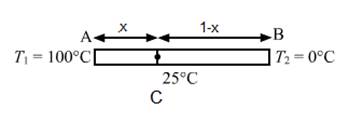
Here, C is the point at which the other end of the rod is placed.
Distance between A and C = x
Distance between C and B = 1-x

Formula used:
Rate of amount of heat flowing or heat current is given as:

Here, Δθ is the amount of heat transferred, ΔT is the temperature difference, K is the thermal conductivity of the material, A is the area of cross section of the material and x is the thickness or length of the material.
Now, for zero heat current in the rod, the temperature difference must be zero: ΔT = 0.
Since one end of the rod is maintained at 25 °C, the other end must be maintained at 25 °C.
Hence heat current between A and C must be equal to the heat current between C and B



Here (ΔT)AC and (ΔT)CB is the temperature difference between AC and BC respectively.

75(1-x) = 25x
75 -75x = 25x
75 = 100x
x = 75/100
x = 0.75 m
Hence, in order to have zero heat current through the rod the other end of the rod must be placed at a distance of 0.75 m from the end at 100 ° C.


More from this chapter

All 67 →
9

Water at 50°C is filled in a closed cylindrical vessel of height 10 cm and cross-sectional area 10 cm2. The walls of the vessel are adiabatic but the flat parts are made of 1 mm thick aluminium (K = 200 J s–1 m–1 °C–1). Assume that the outside temperature is 20°C. The density of water is 1000 kg m–3, and the specific heat capacity of water = 4200 J k–1 m–1 °C–1. Estimate the time taken for the temperature to fall by 1.0°C. Make any simplifying assumptions you need but specify them.

10

The left end of a copper rod (length = 20 cm, area of cross-section = 0.20 cm2) is maintained at 20°C and the right end is maintained at 80°C. Neglecting any loss of heat through radiation, find

(a) the temperature at a point 11 cm from the left end and


(b) the heat current through the rod. Thermal conductivity of copper = 385 W m–1 °C–1.


12

A cubical box of volume 216 cm3 is made up to 0.1 cm thick wood. The inside is heated electrically by a 100 W heater. It is found that the temperature difference between the inside and the outside surface is 5°C in steady state. Assuming that the entire electrical energy spent appears as heat, find the thermal conductivity of the material of the box.

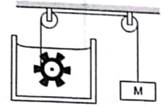
13

Figure shows water in a container having 2.0 mm thick walls made of a material of thermal conductivity 0.50 W m–1 °C–1. The container is kept in a melting ice bath at 0°C. The total surface area in contact with water is 0.05 m2. A wheel is clamped inside the water and is coupled to a block of mass M as shown in the figure. As the block goes down, the wheel rotates. It is found that after some time a steady state is reached in which the block goes down with a constant speed of 10 cm s–1 and the temperature of the water remains constant at 1.0°C. Find the mass M of the block. Assume that the heat flows out of the water only through the walls in contact. Take g = 10 m s–2.